
It happens quickly in IEP and problem-solving meetings. A student is described as “too distractible” in the general education classroom, and before long, the team is discussing resource room time, small group instruction, or another place where the student might be more successful.
But distractibility is not a placement decision. It’s information. It tells us a student may need more support with engagement, instruction, the environment, or the task itself. For school leaders, the goal is to slow the conversation down before “distractible” becomes a reason to remove a student.
A Quieter Room Doesn’t Solve Distractibility
There’s an understandable appeal to moving a student somewhere quieter. Fewer people, fewer materials, fewer conversations, fewer things competing for attention. The student may even appear more focused there.
But that doesn’t tell us whether we’ve solved the problem.
If a student can focus in a highly controlled setting but struggles when they return to science, ELA, or social studies, we’ve learned something useful. The supports haven’t yet been embedded where the student needs them.
Pull-out may change the environment temporarily. It doesn’t necessarily teach a student how to participate successfully in the environment they’re expected to return to. And it comes with tradeoffs. Students can lose instructional time, access to peers, classroom membership, and opportunities to practice skills in the context where they’ll actually use them.
Look at Instruction Before Location
When distractibility comes up, leaders can help teams stay focused on the problem they’re actually trying to solve.
Sometimes the barrier is the amount of language in an assignment. Sometimes students need work broken into manageable chunks, clearer visual information, more predictable routines, movement, or shorter periods of sustained work. Sometimes the lesson simply needs more opportunities to interact, make choices, work with a partner, or actively do something with the content.
Those aren’t special education locations. They’re instructional decisions. And many of them improve learning for far more than the student who started the conversation.
Bottom line? Before changing where a student learns, make sure the team has examined what might need to change about how the student is being asked to learn.
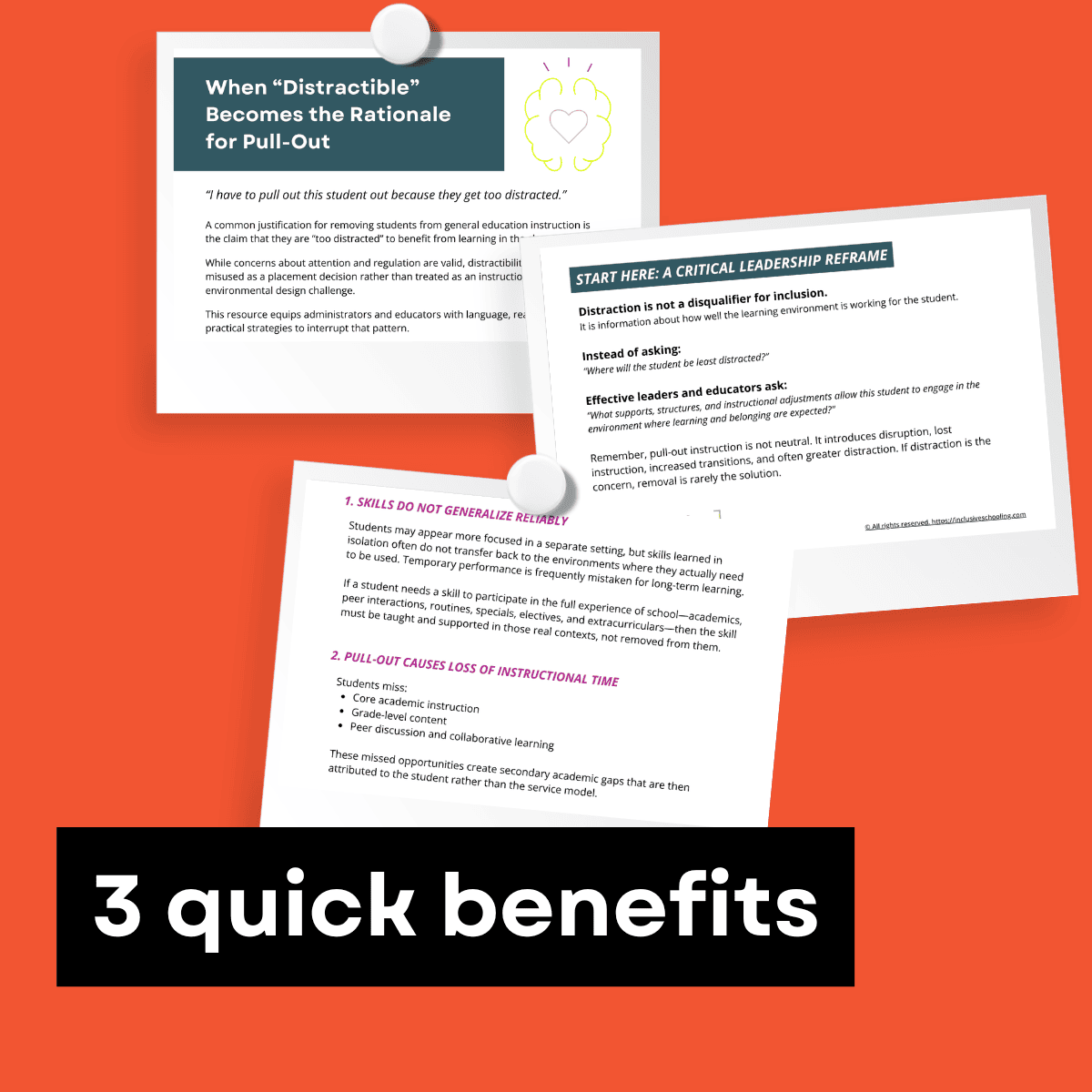
Is distractibility a reason to remove a student from the general education classroom?
Distractibility alone should not determine placement. It signals that a team needs to examine the student’s instruction, environment, engagement, tasks, and supports. Teams can then determine what the student needs to participate and learn successfully.
What can schools try before pull-out instruction for a distractible student?
Start by improving access within the classroom. Depending on the student, that might include more predictable routines, visual supports, movement, shorter work intervals, clearer steps, meaningful choices, or more interactive instruction. The right support depends on what’s getting in the way of engagement.
Why might a student appear less distractible in a resource room?
A smaller or quieter environment may reduce competing demands temporarily. If the student struggles again after returning to the general education classroom, however, the underlying need hasn’t necessarily been addressed. The team still needs to determine what supports will help the student participate in the setting where learning occurs.