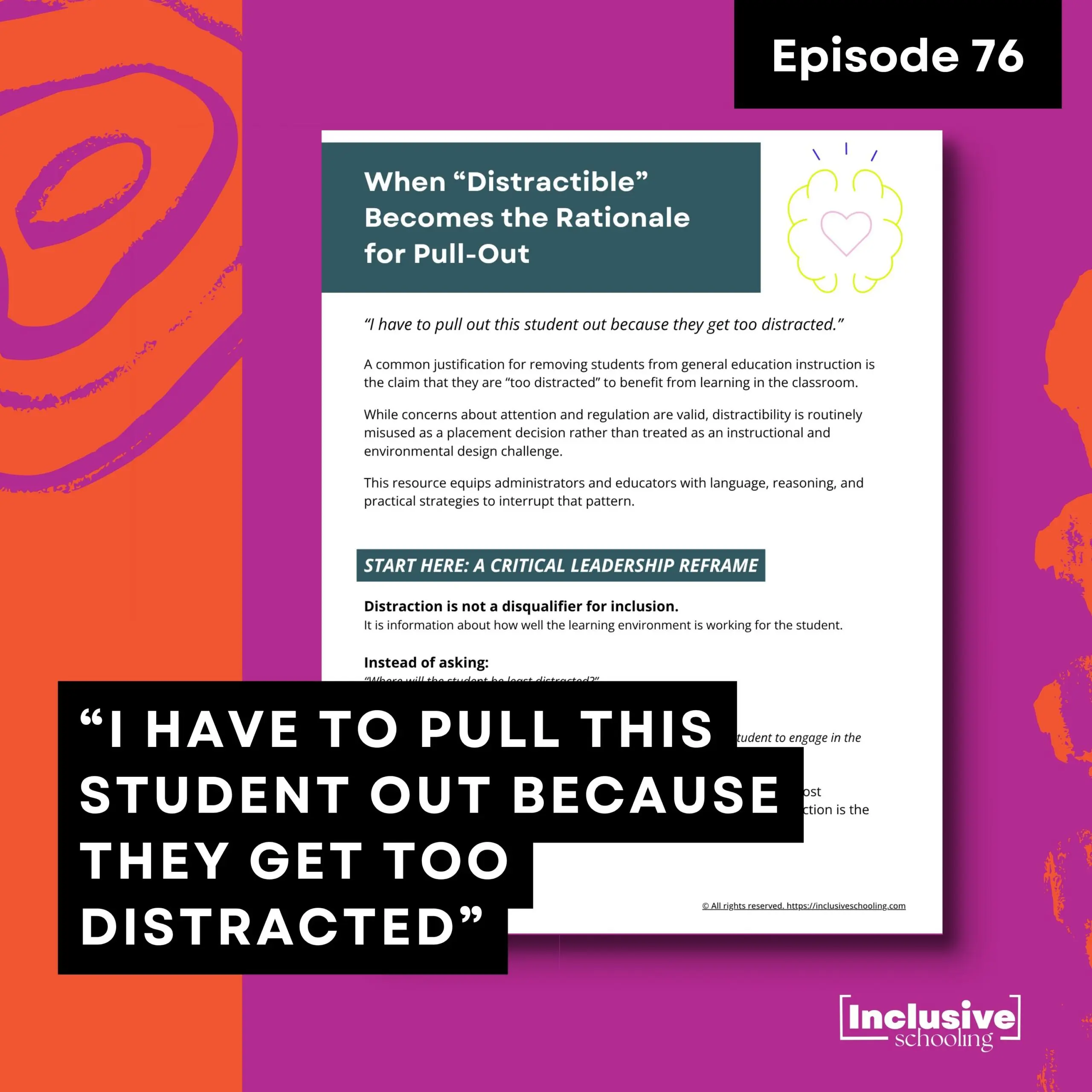
"They’re Too Distractible”… Is NOT a Reason for Pull-Out
Transcript [pdf]
SHOW NOTES
In this episode, Julie and Kristie challenge a common leap in schools: a student is described as “too distractible,” and suddenly the conversation shifts to removing them from the general education classroom. They unpack why distractibility is information—not placement—and how teams can slow down the rush to pull-out by looking first at instruction, environment, engagement, and supports.
Key Takeaways
-
- Distractibility is not a placement decision. It is information that tells us a student may need different or additional support.
- A quieter or smaller room may make a student look more regulated in the moment, but that does not mean the skill or regulation will generalize back to the classroom.
- Pull-out can cost students instructional time, membership, access to peers, and opportunities to learn in the context where the support is actually needed.
- Before changing placement, teams can ask what environmental, instructional, or engagement supports could be tried in the general education setting first.
- Many supports that help a student who is easily distracted—movement, visual supports, predictable routines, choice, shorter work intervals, and more interactive instruction—make classrooms better for everyone.
Answering a Common Question
What can I say when distractibility is being used as a reason for pull-out?
Try slowing the conversation down with questions like:
-
- “Before we talk about removing the student, can we talk about what supports might help them stay engaged?”
- “If distractibility is a concern, what strategies could we try in the general education setting first?”
- “What environmental supports might help reduce distractions?”
- “How will moving the student to another room address the distractibility?”
- “Is the issue distractibility, or is the issue that the instruction isn’t accessible yet?”
These questions shift the team from “Where should this student go?” back to “What would it take for this student to succeed right here?”
Episode Download / Handout
When “Distractible” Becomes the Rationale for Pull-Out
This six-page resource helps teams examine the risks of pull-out, reframe distractibility as a support and access issue, and use practical questions to keep IEP and problem-solving conversations focused on what the student needs to participate and learn.
You’ll find:
-
- well-documented problems with pull-out instruction;
- questions and scripts you can use when removal is being proposed;
- ways to think about distractibility through the environment, instruction, and engagement; and
- inclusive supports to try before changing where a student learns.
👉 Get the handout at: inclusiveschooling.com/download76
Practical Moves to Try
-
- Increase engagement with more interactive instruction, partner learning, hands-on activities, and meaningful choices.
- Reduce task barriers by chunking assignments, using guided notes or visuals, and shortening work intervals when needed.
- Add predictable structure with visual schedules, checklists, clear expectations, and step-by-step directions.
- Build movement into learning through standing options, flexible seating, movement breaks, and transitions between tasks.
- Look for the environmental stressor or access barrier before assuming the student needs a different placement.
Additional Resources
Recognizing and Reducing Stressors: Tools for Teachers and Administrators: A practical companion for looking beyond the student and identifying environmental, instructional, social, and other stressors that may be contributing to what looks like distractibility or challenging behavior.
The Stay-Put Toolbox: A collection of classroom supports designed to help students stay, participate, and receive the support they need without routinely being pulled aside, sent out, or moved to another space.
Inclusion Podcast Episode 70- When “Doing Nothing” Is Actually Doing Something: Reframing Engagement: This episode challenges narrow definitions of engagement and helps educators look more carefully at what participation can look like before deciding that a student is checked out, off task, or unable to learn in the classroom.