Multisensory Magic: Co-Teaching On the Fly with One Teach, One Make
Transcript [pdf]
SHOW NOTES
Key Takeaways
-
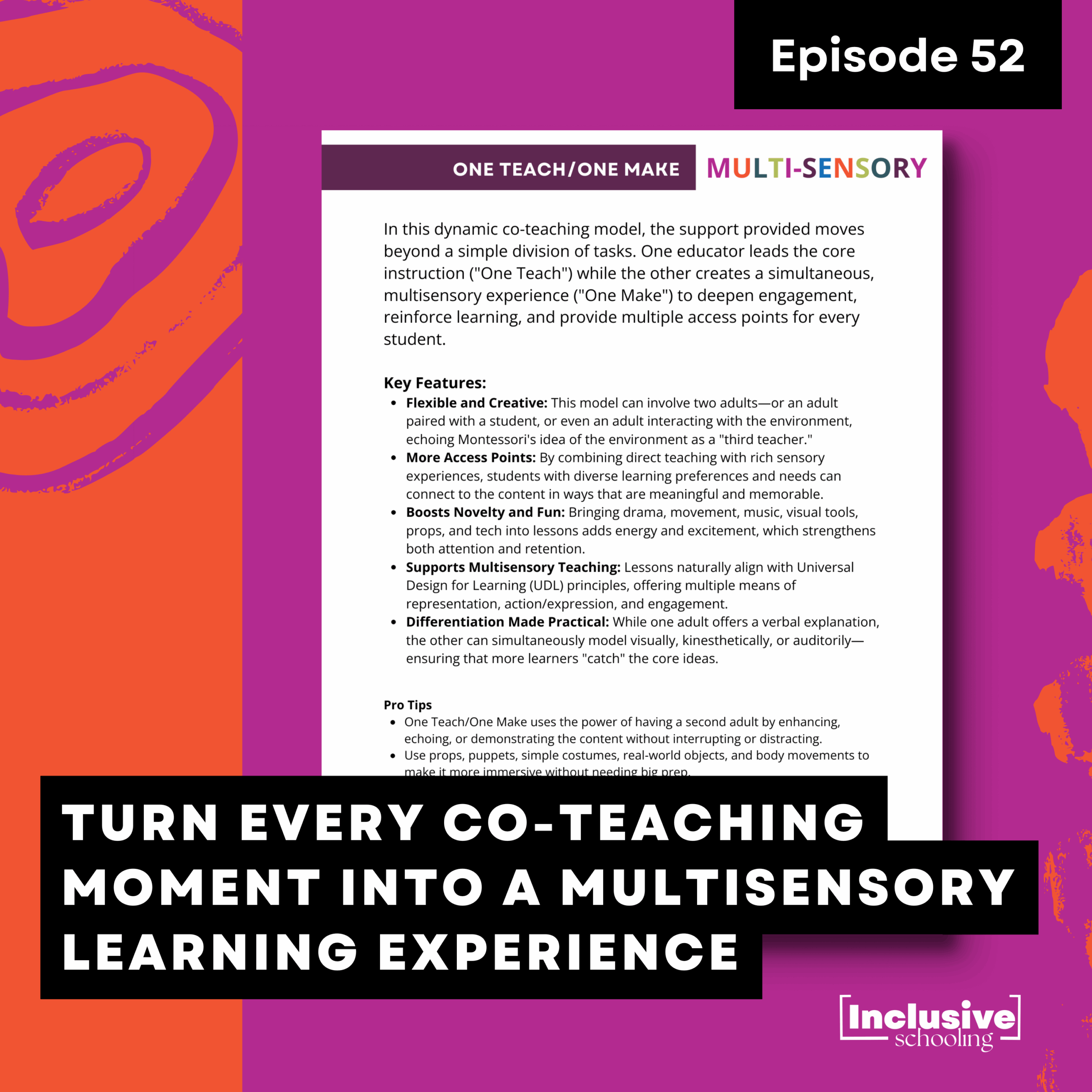
- One Teach, One Make Multisensory is one of our all-time favorite co-teaching strategies because it fully engages both adults and gives students multiple access points to the same content.
- This model builds novelty, creativity, and fun into lessons— whether planned or on the fly— while still ensuring parity and purposeful roles for both co-teachers.
- The approach works for any subject or grade level and even with the environment acting as a “third teacher” to add sensory elements like visuals, textures, smells, or sounds.
- One Teach, One Make Multisensory is one of our all-time favorite co-teaching strategies because it fully engages both adults and gives students multiple access points to the same content.
Episode Download / Handout
Turn Every Co-Teaching Moment Into a Multisensory Learning Experience
Bring lessons to life with a simple, powerful model where one adult teaches and the other makes learning unforgettable through movement, visuals, sound, and touch.
This free guide gives you dozens of real examples— across subjects and grade levels—showing how to combine direct instruction with rich, multisensory engagement so every learner has multiple ways to connect to the content.
-
- Instant ideas you can use tomorrow— no big prep needed
- Multiple access points for diverse learning needs
- More novelty and fun to keep students focused and participating
- Instant ideas you can use tomorrow— no big prep needed
Download the free handout here
Highlights from the Handout
-
- Julie’s Favorite: Reading aloud while the other adult acts out characters using props or puppets— doubling the sensory engagement for students.
- Kristie’s Favorite: Whole-class discussions where one teacher facilitates while the other uses playful, unexpected engagement tactics (think plaid jacket and “game show” energy).
- Julie’s Favorite: Reading aloud while the other adult acts out characters using props or puppets— doubling the sensory engagement for students.
Practical Tips
-
- Talk with your co-teacher ahead of time when possible, but also be open to spontaneous ideas— trust and communication make both planned and in-the-moment creativity work.
- Extend beyond verbal + visual: layer in smell, texture, sound effects, and movement to make learning three-dimensional.
- Remember— this strategy isn’t just for elementary. It’s powerful in middle and high school, too. Check out our One Teach, One Make Multisensory Chemistry Examples for inspiration on applying it to complex content like chemistry labs, phase changes, and stoichiometry.
- Talk with your co-teacher ahead of time when possible, but also be open to spontaneous ideas— trust and communication make both planned and in-the-moment creativity work.
Additional Resource
-
- Co-Regulation: What is this exactly and what could it look like in my classroom: This video [5:55] from Dr. Lori Desautels highlights the importance of educators creating supportive, responsive environments where students feel safe and connected. It emphasizes that co-regulation is not about control, but about fostering trust, modeling calm, and helping learners build their own self-regulation skills. The message underscores that every child deserves to be seen, supported, and guided with compassion, so they can thrive academically and socially. This approach affirms the dignity of all learners while nurturing inclusive, caring classrooms.