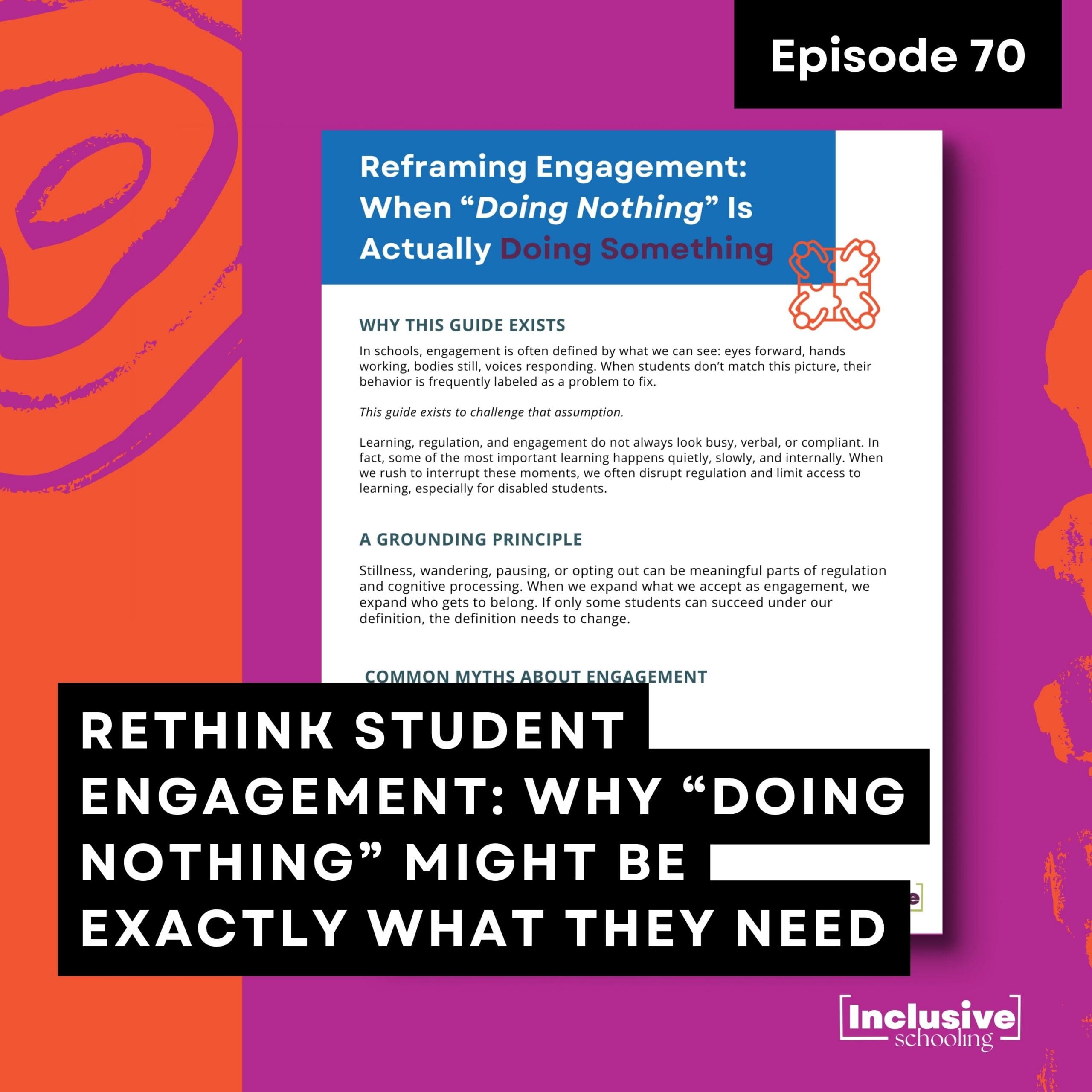
When “Doing Nothing” Is Actually Doing Something: Reframing Engagement
Transcript [pdf]
SHOW NOTES
What This Episode Is About
What if “doing nothing” isn’t disengagement… but regulation?
In this episode, Julie and Kristie challenge one of the most persistent assumptions in education: that learning must look busy, verbal, and compliant.
If you are:
-
- Redirecting students who “look off task”
- Supporting students who need more time, space, or movement
- Wondering how to define engagement more inclusively
- Trying to reduce behavior corrections and increase access
Key Takeaways
-
- Engagement is often invisible, internal, and non-linear.
- Stillness, movement, pausing, or even opting out can be part of regulation and learning.
- Traditional definitions of engagement often prioritize adult comfort over student needs.
- Interrupting regulation can actually disrupt learning and escalate behavior.
- Expanding how we define engagement expands who gets to belong.
Why Our Definition of Engagement Needs to Change
In many classrooms, engagement is defined as:
-
- Eyes forward
- Hands working
- Bodies still
- Immediate responses
But these expectations:
-
- Favor certain learners over others
- Ignore differences in processing and regulation
- Create unnecessary corrections and power struggles
What Engagement Can Look Like (Real Examples)
Engagement might include:
-
- Listening without responding
- Watching peers before joining
- Staring out the window while thinking
- Moving, pacing, or fidgeting
- Pausing between bursts of work
- Briefly opting out, then rejoining
Regulation vs. Avoidance (A Critical Distinction)
Regulation
-
- Supports the nervous system
- Helps the student return to learning
- May look quiet, slow, or internal
- Is often temporary
Avoidance
-
- Prevents access to learning
- Persists despite support
- Increases stress over time
The goal is not to eliminate all “off-task” behavior, it’s to understand what it means. Because when engagement is defined too narrowly, we unintentionally exclude students who learn differently.
Episode Download / Handout
Reframing Engagement: When “Doing Nothing” Is Actually Doing Something
This practical guide helps educators rethink engagement through a regulation-first, inclusive lens.
Inside the download, you’ll find:
-
- A clear explanation of why engagement doesn’t always look visible
- Examples of what engagement can actually look like (quiet, slow, internal)
- A critical distinction between regulation vs. avoidance
- The cost of interrupting regulation in classrooms
- Language shifts to reframe how teams talk about student behavior
- Reflection prompts to build more inclusive definitions of participation
👉 Download at: inclusiveschooling.com/download70
The Adult Reality Check
Adults regulate all the time:
-
- We stare out windows
- We take breaks
- We move while thinking
- We pause before responding
We don’t call this disengagement. We call it thinking.
Additional Resources
Fast Finisher Cards are thoughtfully designed prompts that give students meaningful, self-directed options when they complete work early, helping maintain engagement without adding unnecessary or repetitive tasks. They offer a range of creative, reflective, and skill-building activities that support independence, student choice, and continued learning across diverse interests and ability levels. You can review the three types below:
A Fresh Look at Learning Centers: This resource highlights the importance of shifting from behavior management to relationship-centered practices in early childhood settings, emphasizing connection, co-regulation, and understanding the root of children’s behavior. It offers practical, reflective guidance for educators to move beyond compliance-based approaches and instead create inclusive, responsive environments where young children feel safe, understood, and supported in their development. These ideas align with a broader commitment to honoring children’s right to learn through play and belonging.