
One of the most common things school leaders hear is: “This student needs a small group.”
The statement usually comes from a place of care. A student is struggling, a team wants to help, and small group instruction feels like the obvious solution.
The problem is that “small group” often becomes a description of a place rather than a teaching strategy. Before moving a student, pause and ask: What is happening in that small group that cannot happen here?
What Teams Are Really Asking For
When teams describe a successful small group experience, they rarely talk about the room itself. Instead, they describe instruction that is more responsive. Students may have more opportunities to participate, more flexibility in how they engage with content, clearer expectations, stronger relationships, or more support when they get stuck. Those are valuable practices. They also are not unique to a separate setting. More differentiation, more flexibility, more choice, more support, and more opportunities for engagement are instructional practices, not locations. When we recognize that, the focus shifts from where the student learns to how the student learns.
The Leadership Opportunity
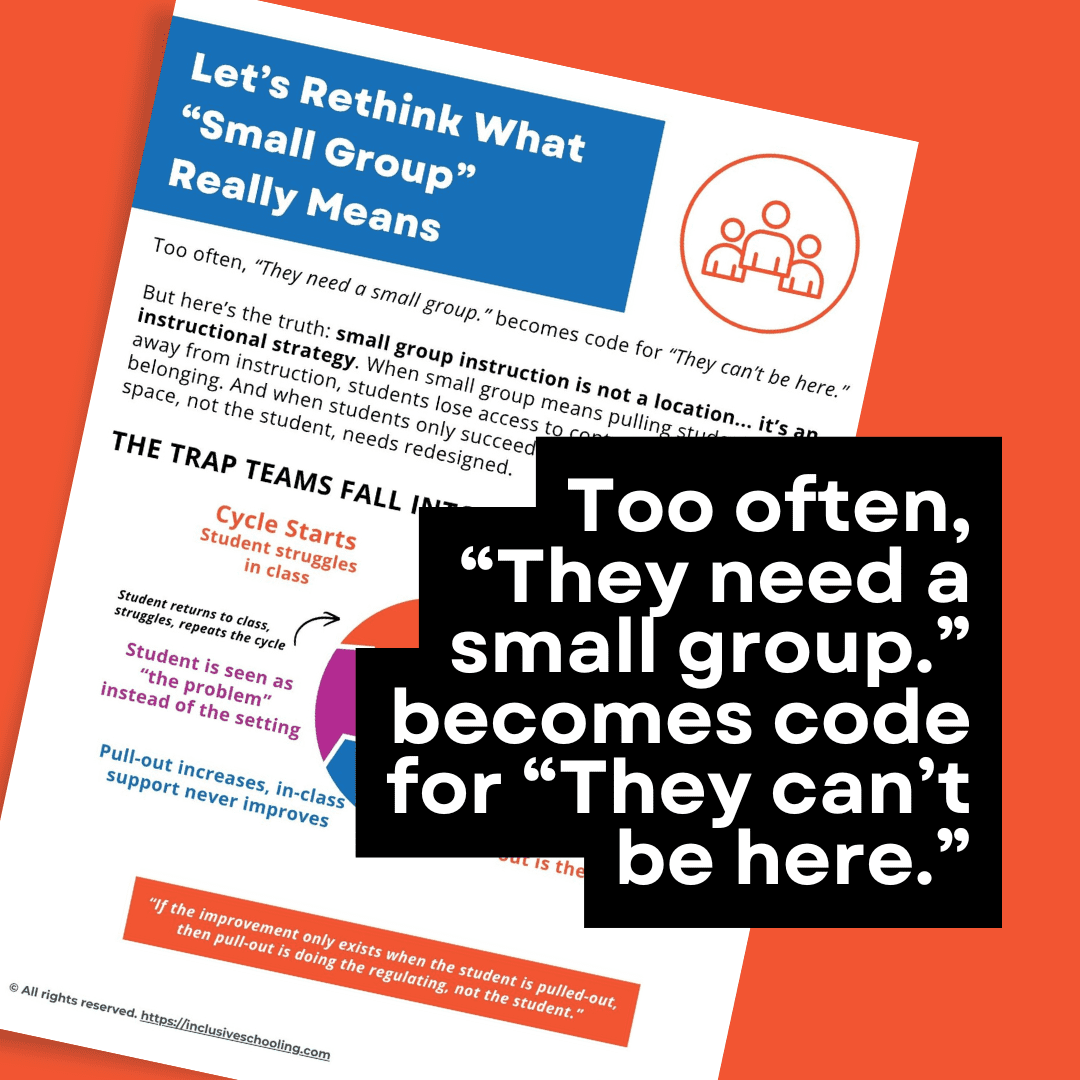
Too often, schools change placement before they examine instruction.
A student struggles, receives support in a separate setting, and begins to show progress. The team sees improvement and assumes the location was the solution. Meanwhile, the instruction in the general education classroom remains unchanged.
Over time, this creates a cycle where more and more support happens outside the classroom while fewer conversations happen about access, engagement, and instructional design.
Leaders have an opportunity to interrupt that cycle.
When a team recommends a pull-out group, ask them to identify exactly what is making that support effective. If the student benefits from additional wait time, flexible grouping, opportunities to process before responding, or multiple ways to demonstrate understanding, those are practices that can often be embedded into classroom instruction.
Small Groups Matter
None of this is an argument against small groups. Effective small group instruction is one of the most powerful tools educators have. Students benefit from working with peers, receiving targeted support, and engaging with content in different ways.
The goal is not to eliminate small groups.
The goal is to stop using “small group” as a reason to remove students before we’ve fully examined what can be improved in the classroom. When a student struggles, the first response should not be changing where they learn. It should be looking at how we can make learning more accessible.
Do students with disabilities benefit from small group instruction?
Absolutely. Small group instruction is an effective teaching strategy for many learners. The key question is whether students need a separate location or whether the instructional practices that make small groups effective can be provided within the general education classroom.
What should school leaders ask when a team recommends a pull-out group?
Ask what is making the small group successful. If the answer is more flexibility, differentiation, participation, or support, those practices may be able to happen within the classroom rather than requiring a different placement.
How can schools provide small group support without pulling students out?
Many schools use flexible grouping, station teaching, peer collaboration, choice-based activities, and differentiated instruction to provide support while maintaining access to grade-level content, peers, and the general education classroom.