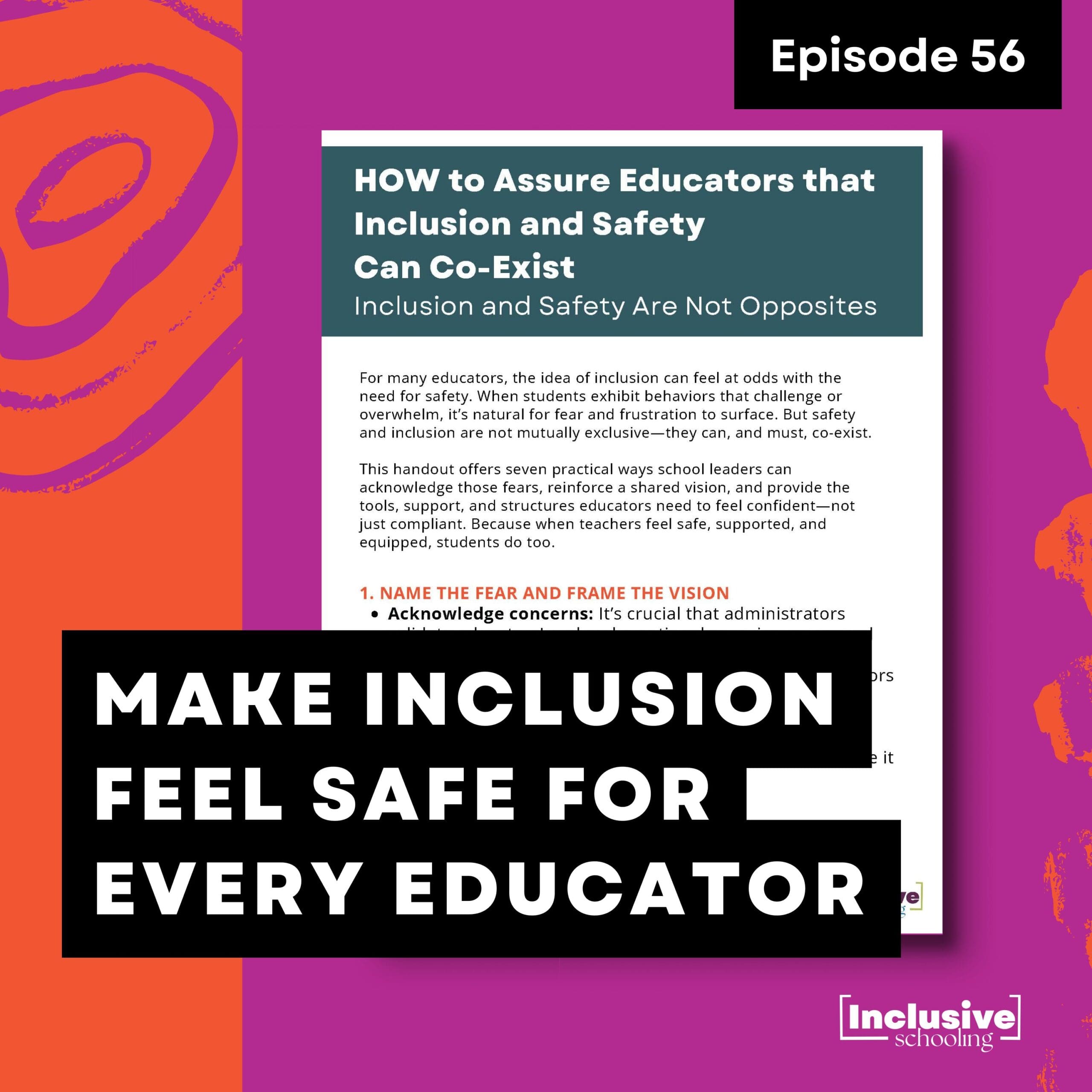
Inclusion and Safety Can Coexist
Transcript [pdf]
SHOW NOTES
Key Takeaways
-
- Inclusion and safety are not opposites. Inclusive classrooms can actually be safer than segregated ones because students feel more connected, supported, and less stigmatized.
- Fear often comes from assumptions. Concerns about safety are frequently rooted in ableist beliefs and outdated behavior management practices.
- Name the fear, frame the vision. Acknowledge concerns openly while reinforcing the shared responsibility to keep all students safe.
- Safety without exclusion. Schools can set clear safety boundaries without resorting to segregating or removing students.
- Celebrate “success minutes.” Focusing on moments of regulation and success helps reframe thinking from crisis to growth.
- Inclusion and safety are not opposites. Inclusive classrooms can actually be safer than segregated ones because students feel more connected, supported, and less stigmatized.
Episode Download/Handout
The free companion guide — Inclusion and Safety Can Coexist — includes practical resources to support educators in creating safe, inclusive classrooms:
-
- De-escalation techniques to calm challenging situations.
- Student support plan templates to build individualized, proactive strategies.
- Success minutes tracking tools to shift focus toward progress.
- De-escalation techniques to calm challenging situations.
👉 Download at inclusiveschooling.com/download56
Highlights from the Handout
-
- Julie’s Favorite: Name the fear and frame the vision — listen, acknowledge, and then reaffirm that safety and inclusion go hand in hand.
- Kristie’s Favorite: Shift from managing to teaching self-regulation — equip students with tools to handle emotions instead of relying on exclusion.
- Julie’s Favorite: Name the fear and frame the vision — listen, acknowledge, and then reaffirm that safety and inclusion go hand in hand.
Practical Tips
-
- Provide proactive training: Equip staff with clear, actionable de-escalation strategies instead of vague reassurance.
- Model “we’re in this together”: Build a collaborative team mindset so safety is a shared responsibility.
- Track small wins: Notice and celebrate even a few minutes of success to shift perspective and guide future planning.
- Provide proactive training: Equip staff with clear, actionable de-escalation strategies instead of vague reassurance.
Related Podcast Episodes
-
- [Episode 29] But Inclusion Isn’t Fair to the Other Students: What to Say!– Julie and Kristie tackle one of the most common and frustrating misconceptions about inclusive education: that it’s somehow unfair to other students. With humor, compassion, and insight, they unpack the ableism hidden in this statement and offer practical language educators can use to shift the conversation toward equity and belonging. Listeners will learn how to respond thoughtfully, ask better follow-up questions, and engage both colleagues and families in creating inclusive environments where every student thrives.
- [Episode 45] “But What Will They Get Out of This?”: 20 Responses Every Educator Needs to Hear– Julie and Kristie confront one of the most common arguments used against inclusion: the idea that students with disabilities must prove they’ll “get something” out of a general education class. Through Stephanie’s powerful story of thriving in an 11th-grade English class, they illustrate how access — not ability — is the true foundation of inclusion. This episode offers educators 20 ready-to-use responses to reframe exclusionary thinking, champion equity, and remind us that every student has a right to belong and learn alongside their peers.