Respect The No
Transcript [pdf]
SHOW NOTES
What happens when a student says “no”? Too often, we interpret it as defiance, disrespect, or something that needs to be corrected. But what if that “no” is actually telling us something important?
In this episode, Julie and Kristie explore why respecting a student’s “no” isn’t about lowering expectations or letting students do whatever they want. It’s about understanding what their nervous system may be communicating and creating the safety, trust, and autonomy that make learning possible.
Through real classroom examples, they share how to move beyond power struggles, preserve student dignity, and offer meaningful choices while maintaining expectations for learning and participation.
Key Takeaways
-
- “No” is communication, not necessarily defiance. Refusal may signal overwhelm, fear, sensory discomfort, uncertainty, or a need for autonomy.
- Neurological safety comes before meaningful engagement. When students feel threatened, powerless, or unheard, learning becomes harder.
- Respecting the “no” doesn’t mean removing expectations. We can maintain learning goals while changing the supports, choices, timing, or pathways to participation.
- Autonomy matters for every learner. For students with a persistent drive for autonomy (PDA), flexibility, choice, and reducing demands may be especially important.
- Trust is built over time. When students know their communication will be respected, they may become more willing to participate, take risks, and accept support.
Episode Download / Handout
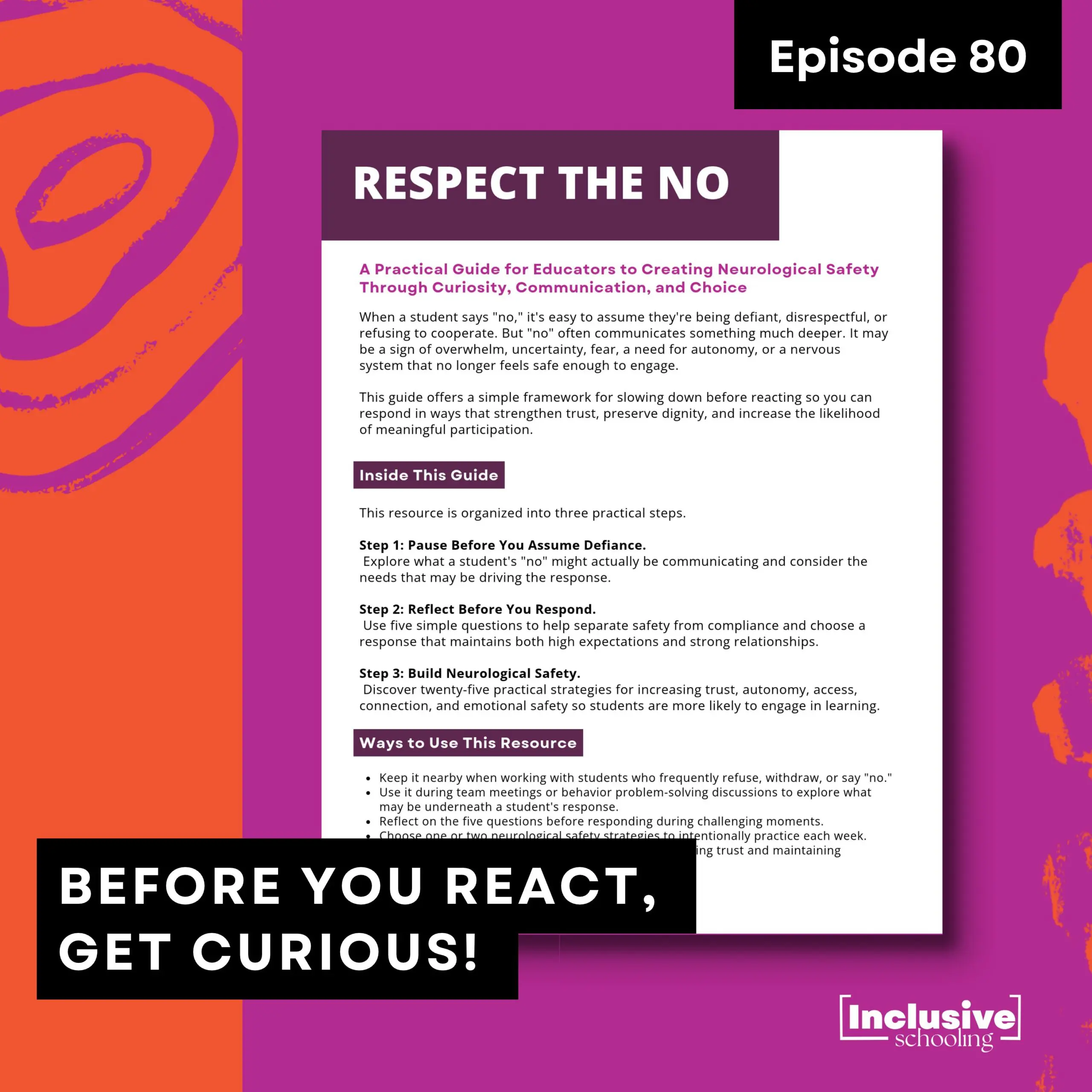
Respect the No: A Practical Guide for Educators
This free three-page guide helps educators move beyond power struggles and respond to student refusal with curiosity, communication, and choice.
Inside, you’ll find:
-
- Step 1: Pause Before You Assume Defiance. Explore what a student’s “no” might actually be communicating.
- Step 2: Reflect Before You Respond. Five questions to help you distinguish safety from compliance, preserve dignity, and maintain expectations.
- Step 3: Build Neurological Safety. Twenty-five practical strategies for increasing trust, autonomy, access, connection, and emotional safety.
Why download it?
Because knowing that “no” is communication is one thing. Knowing what to do next is another. This guide gives you practical ways to respond without escalating the situation, abandoning the learning goal, or getting caught in a power struggle.
👉 Get the handout at: inclusiveschooling.com/download80
Practical Moves for Your Classroom or School
-
- Acknowledge before redirecting. Try “Thank you for telling me” or “I hear you” instead of immediately correcting or challenging the refusal.
- Get curious about what’s underneath the “no.” Consider whether the student needs processing time, sensory adjustments, more information, connection, or a meaningful choice before participating.
- Maintain the goal, change the pathway. A student who doesn’t want to touch papier-mâché might help tear the paper instead. The goal is participation, not forcing everyone to participate in exactly the same way.
- Redefine success in the moment. Success might mean staying in the room, accepting support, becoming more regulated, or taking one small step toward participation. Notice these Success Minutes and build from there.
Additional Resources
The Inclusion Podcast Episode 41: Language That Lifts: Writing IEPs That Inspire Possibility: Julie and Kristie explore how the words we use to describe students shape expectations, opportunities, and support. Learn practical ways to replace deficit-based descriptions with language that recognizes strengths, communicates needs, and preserves dignity.
The Inclusion Podcast Episode 77: Success Minutes: The Mind-Blowing Metric That Changes Everything: What if we tracked what’s going right instead of focusing almost entirely on what’s going wrong? Julie and Kristie introduce Success Minutes, a practical way to notice small moments of engagement, regulation, connection, and participation—and identify the supports that make those moments possible.