
For many school leaders, challenging behavior feels unpredictable—students go from calm to crisis in seconds, and staff are left reacting in the moment. The pressure to “handle it” is constant, and the solutions often focus on what to do after things go wrong.
But what if the most effective behavior support doesn’t happen during the crisis at all?
Why Reactive Behavior Systems Fall Short
Many behaviors labeled as “challenging” are actually predictable responses to environments that lack:
- clarity
- access
- relevance
- connection
When tasks feel confusing, meaningless, overwhelming, or disconnected from students’ strengths, behavior is communication—not defiance. As the Episode 62 transcript emphasizes, we can’t teach during the storm, but we can design environments that reduce how often storms occur in the first place
Proactive strategies don’t eliminate the need for in-the-moment responses—but they significantly reduce how often educators are forced into crisis mode.
What Proactive Design Looks Like in Practice
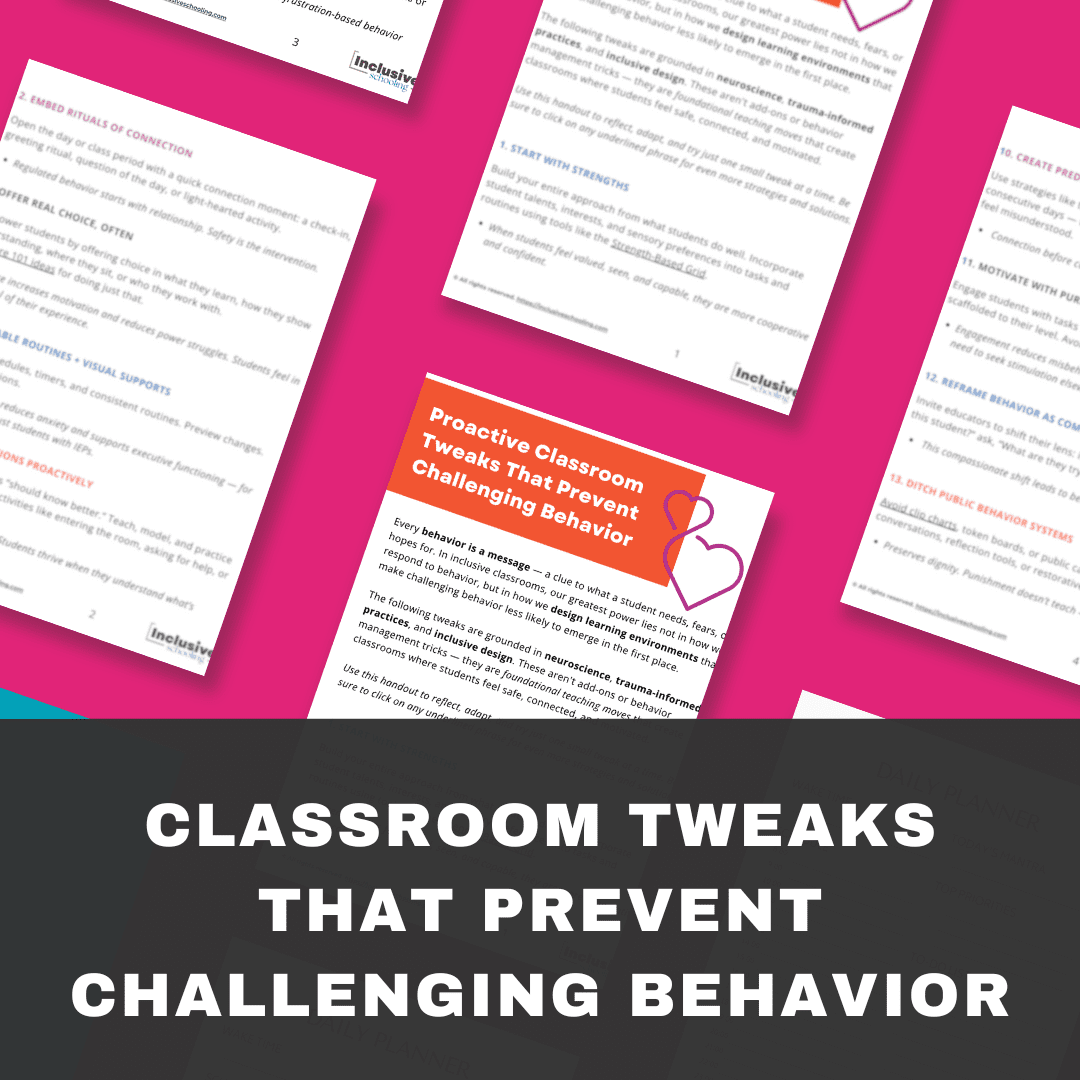
The downloadable guide, Proactive Classroom Tweaks That Prevent Challenging Behavior, outlines 16 research-aligned adjustments that shift behavior support from reaction to prevention
These aren’t add-ons or management tricks—they’re foundational teaching moves grounded in neuroscience, trauma-informed practice, and inclusive design.
Here are a few leadership-level takeaways worth highlighting:
- Design from strengths, not compliance
When instruction is built around what students do well—their interests, talents, and sensory preferences—confidence and cooperation increase. Strength-based environments reduce frustration and disengagement before behavior ever surfaces.
- Increase predictability without eliminating novelty
Clear routines, visual supports, and advance previews calm the nervous system. Predictability helps all learners—not just students with IEPs—while still allowing room for novelty, creativity, and challenge.
- Normalize regulation and choice
When regulation tools (movement, fidgets, calming supports) and meaningful choice are embedded into daily instruction, students don’t need to “earn” access. Power struggles decrease, engagement increases, and classrooms feel safer for everyone.
- Design tasks that motivate instead of frustrate
Repeated, irrelevant, or inaccessible work is a reliable trigger for disengagement. Purposeful, real-world tasks with multiple access points invite participation instead of resistance.
- Remember: students borrow adult regulation
One of the most powerful tweaks is also the simplest: regulated adults create regulated classrooms. When leaders and educators model calm, students borrow that calm in return.
Why This Matters for School Leaders
If your staff is exhausted from constantly responding to behavior, the answer isn’t another consequence system or escalation protocol. It’s intentional design.
Proactive classroom tweaks give leaders a shared framework for walkthroughs, coaching conversations, PLCs, and PD—especially when teams are stretched thin and need changes that actually stick.
Prevention doesn’t mean behavior disappears.
It means it happens less often—and when it does, adults have more capacity to respond with care, clarity, and consistency.
Why do proactive strategies reduce challenging behavior more effectively than consequences?
Because behavior is often a response to unmet needs in the environment. Proactive strategies address stress, confusion, lack of access, and disconnection before they escalate. When classrooms feel predictable, engaging, and supportive, students are less likely to enter dysregulated states that lead to challenging behavior.
Does prevention mean teachers won’t need in-the-moment behavior strategies anymore?
No. Proactive design doesn’t replace real-time responses—it reduces how often they’re needed. When 80% of effort goes into proactive supports, educators spend less time managing crises and more time teaching, connecting, and supporting regulation when challenges do arise.
How can school leaders help staff implement proactive classroom tweaks?
Start small and focus on shared language. Use the classroom tweaks as reflection tools during walkthroughs, team meetings, or PD. Encourage staff to try one adjustment at a time—such as increasing predictability or embedding daily connection—rather than overhauling everything at once.