

School leaders spend a lot of time deciding what to put into professional development. The better question may be what educators will actually do differently because of it.
Effective professional development for teachers should create time to interact with new ideas, talk with colleagues, reflect on current practice, and decide what to try next. That can happen in a full-day training. It can also happen in 30 minutes.
More Content Doesn’t Always Mean Better Professional Development
It is easy to fill a PLC agenda. A few announcements, a PowerPoint, some data, a new strategy, and suddenly the hour is gone. The problem is that covering content isn’t the same as changing practice. Shorter professional learning can leave room for the part we often squeeze out: educators making sense of an idea together and figuring out how it applies to the students they teach. A 15-minute podcast, article, classroom example, or video can become the starting point rather than the entire PD experience.
That also gives leaders more flexibility to connect professional development to what staff need right now rather than delivering the same learning to everyone at the same time.
Give Educators More Choice in How They Learn
We talk constantly about differentiation and choice for students. Then we gather 60 adults in a room and ask them to learn the same thing, in the same way, at the same pace.
There is room for something in between.
If behavior is a school priority, for example, one educator may need support with co-regulation while another needs ideas for reducing stressors or moving away from rewards. Staff can work toward the same larger goal without everyone needing the exact same entry point.
Choice also doesn’t mean sending people a resource and hoping for the best. Leaders still identify the priority, select strong content, protect time for learning, and bring people back together around shared questions and next steps.
Try a Walk and Talk PLC
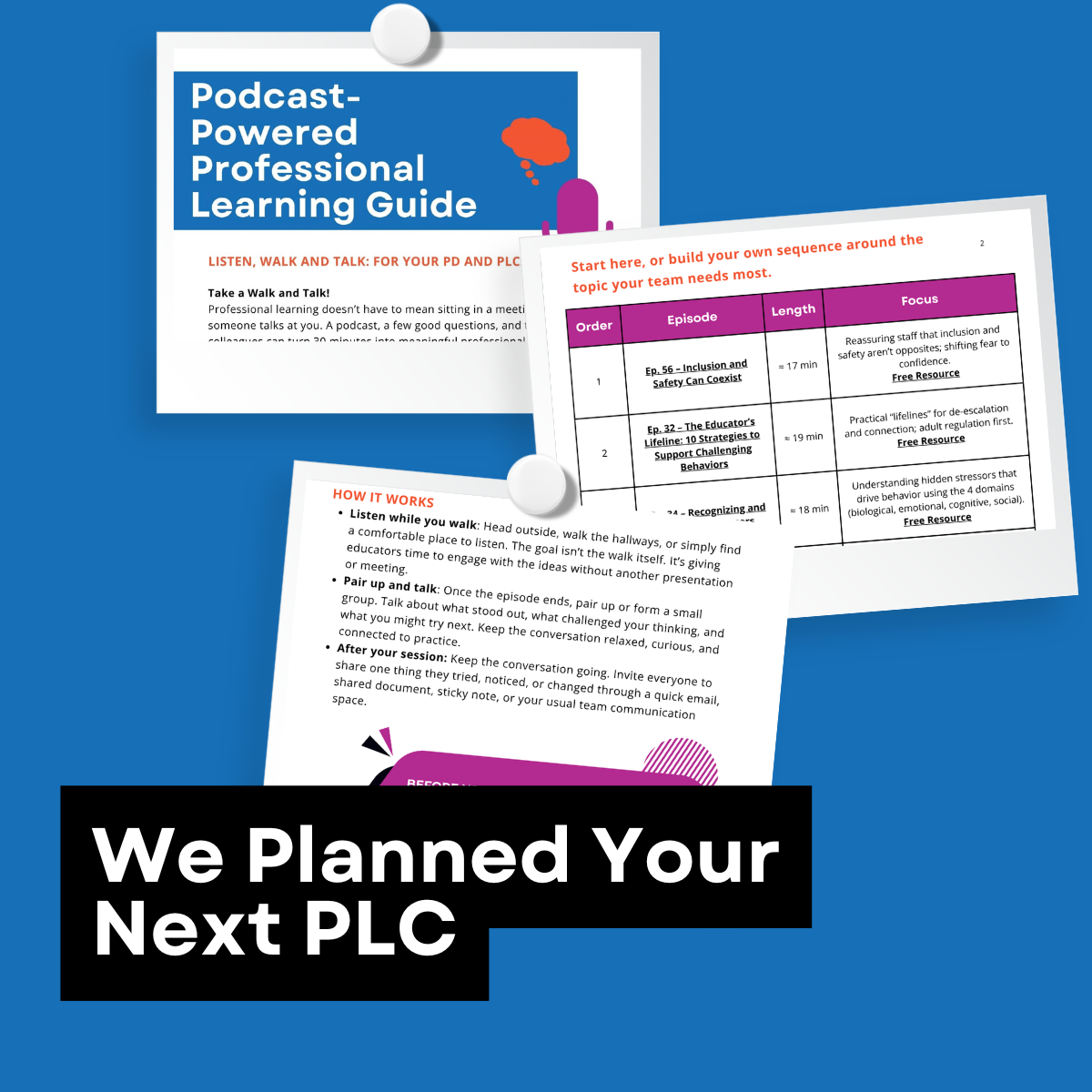
One simple option is a Walk and Talk PLC. Give staff a short piece of content connected to a current school priority, let them listen while they walk or find another comfortable place, and then provide time to talk with a colleague.
The walking isn’t really the point. The interaction is.
Before planning the next staff meeting or professional learning session, look at your agenda and ask what percentage of the time is devoted to receiving information versus talking, reflecting, applying, and planning. You don’t necessarily need another PD topic. You may need to make more room for educators to do something with the learning you’ve already provided.
Your job as the leader is to keep the focus narrow enough that staff have time to get beyond “That was interesting”, and into “Here’s what this means for our practice”. The companion guide offers a structure for doing that before, during, and after a PLC without turning it into another elaborate initiative.
What makes professional development effective for teachers?
Effective professional development gives educators opportunities to engage with relevant content, interact with colleagues, reflect on their current practice, and apply what they are learning. The amount of content covered matters less than whether educators leave ready to try something differently.
How can school leaders improve PLC meetings?
Start with one clear instructional priority and protect time for discussion and application. Rather than filling the meeting with presentations and updates, use a short resource as the starting point and give educators time to connect it directly to their classrooms.
Can podcasts be used for teacher professional development?
Yes. Podcasts can provide short, flexible professional learning that educators can access individually and then discuss with colleagues. They work best when leaders connect the episode to a school priority and provide questions, reflection time, and an opportunity to apply the learning rather than simply assigning an episode to listen to.