
Any time two adults share responsibility for students, co-teaching is happening, whether that pairing lasts all day or just one period.
And yet, most co-teaching challenges aren’t about instruction.
They’re about relationships.
When trust is weak, small differences turn into tension. When trust is strong, differences become assets.
Why Co-Teaching Breaks Down (Even with Good Intentions)
Leaders often hear:
- “We just don’t communicate the same way.”
- “It feels uneven.”
- “We’re stepping on each other’s toes.”
These challenges usually aren’t about competence. They’re about unspoken assumptions, stress responses, and mismatched working styles.
Strong co-teaching doesn’t require identical personalities, it requires intentional relationship-building.
What Effective Co-Teaching Teams Do Differently
Healthy co-teaching partnerships share three habits:
They get curious instead of defensive
Differences in planning, pacing, or communication aren’t problems to fix, they’re signals to explore.
They talk before things get hard
Discussing preferences, boundaries, and stress responses early prevents resentment later.
They encourse honest conversation
Parity isn’t equal airtime. It’s a shared purpose, mutual respect, and the ability to say, “That didn’t land well for me.” Leaders who protect time and space for these conversations see stronger collaboration and better outcomes for students.
Who counts as a co-teacher?
Any two adults responsible for students at the same time, general educators, special educators, paraprofessionals, specialists, or related service providers.
Do co-teachers need the same teaching style to work well together?
No. Differences are often strengths. What matters is trust, communication, and clarity, not sameness.
How can leaders support better co-teaching without adding more meetings?
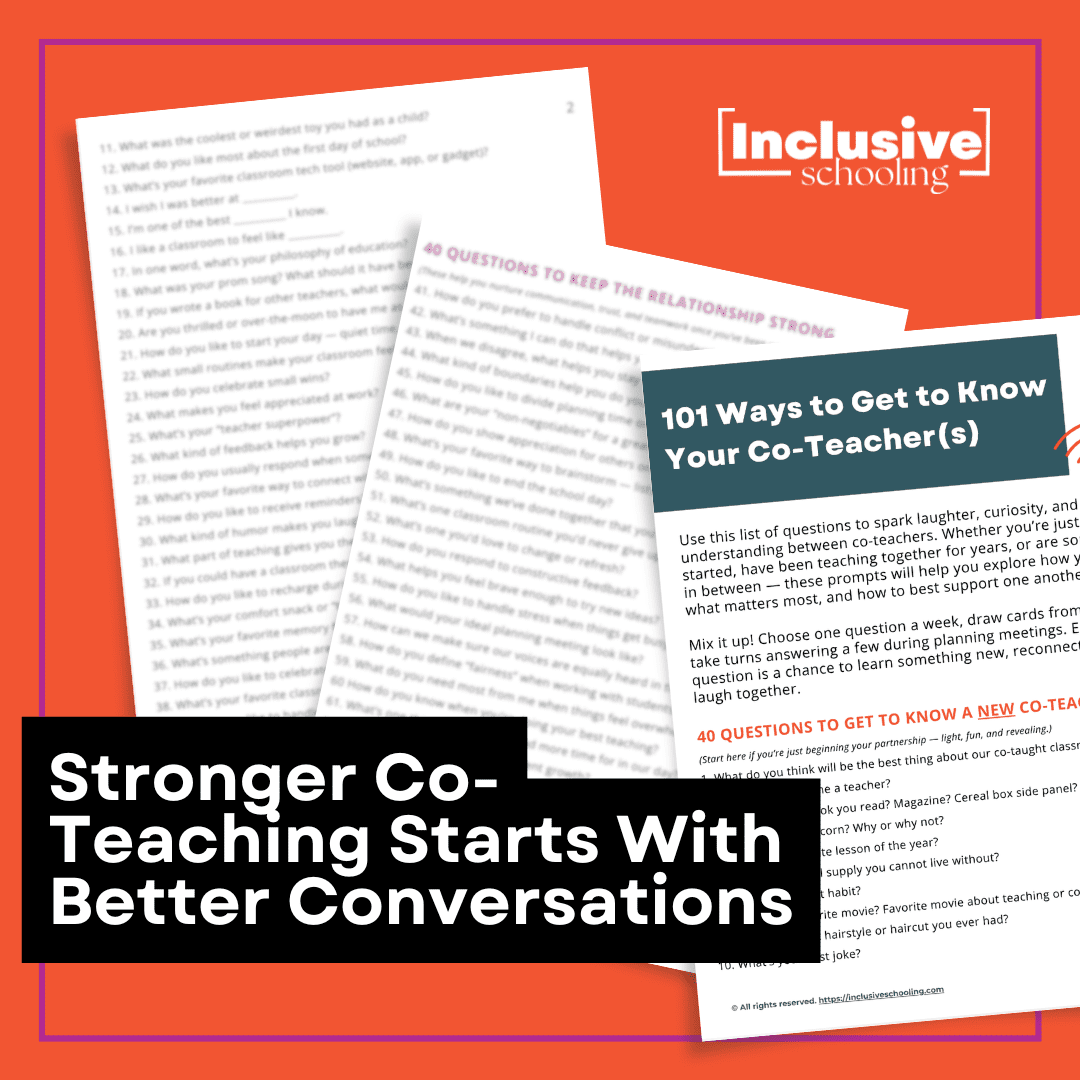
By providing simple tools that prompt meaningful conversation and by normalizing relationship-building as part of the work, not an extra.