If you’ve ever been in a co-taught classroom, you know the familiar trap: one teacher leads the lesson while the other… watches. They might circulate, stand to the side, or offer quiet support—but they’re not fully engaged. And that’s a missed opportunity for every learner in the room.
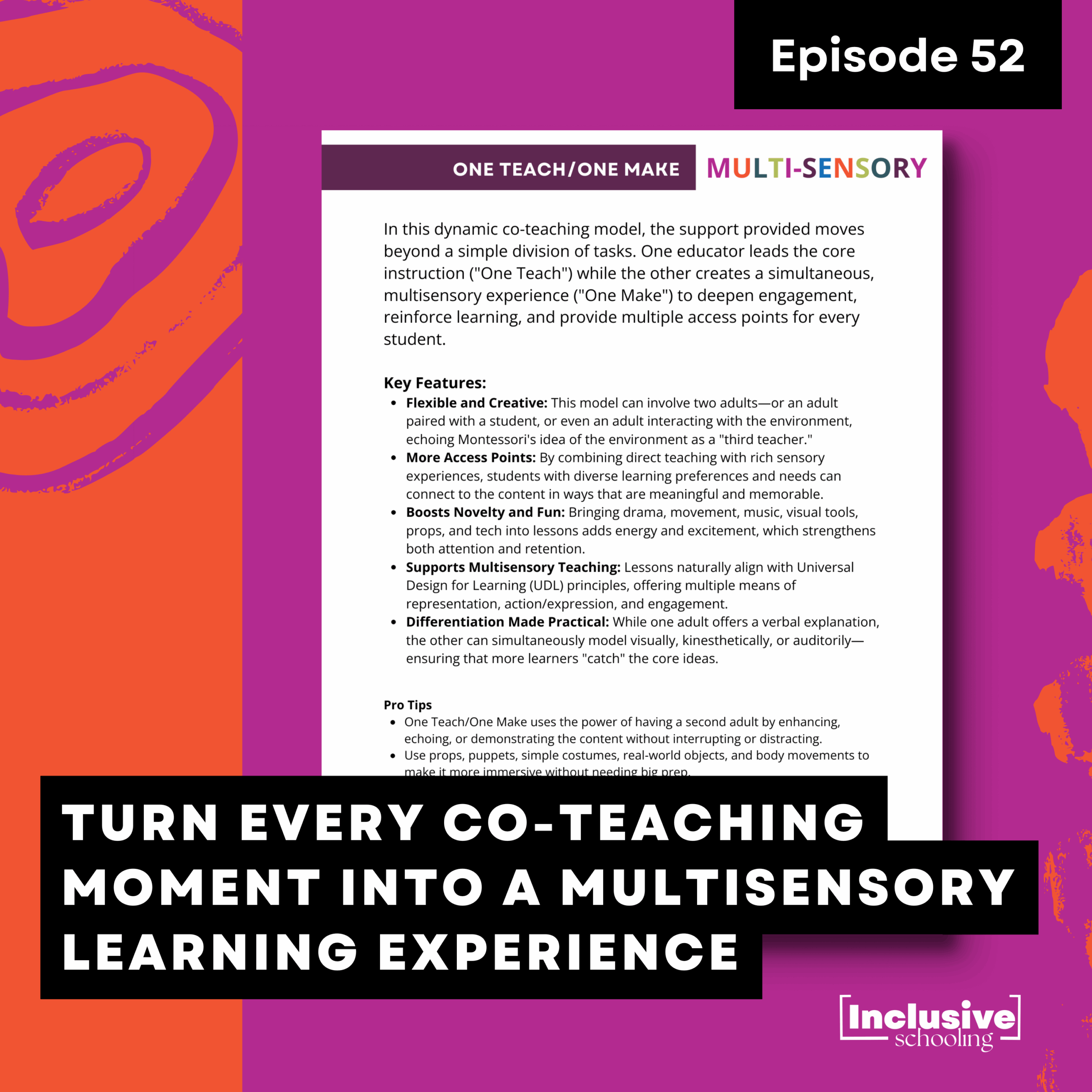
One Teach, One Make Multisensory changes that. It’s one of the most effective co-teaching strategies for inclusive classrooms because it ensures both educators are active, purposeful, and contributing to student learning at the same time. The result? More access points, more engagement, and more memorable learning moments—all without doubling your prep time.
Why This Co-Teaching Model Works in Inclusive Classrooms
Your students bring a wide range of needs, strengths, and learning preferences. In many schools, old-fashioned practices and low expectations mean some students—especially those with disabilities—don’t get full access to the general education curriculum. This model helps change that.
By pairing direct instruction with multi-sensory experiences—movement, visuals, sound, texture, even smell—you give every learner more than one way to connect to the content. That’s not just good teaching; it’s aligned with Universal Design for Learning (UDL) and proven to improve outcomes for students with and without disabilities.
How It Works
- One teacher delivers the core content.
- The other enhances the lesson with multi-sensory elements—props, demonstrations, sound effects, or physical movement—that reinforce and expand on what’s being taught.
This simple shift transforms co-teaching from “one teaches, one watches” to both teach, both engage, both make learning stick.
Examples You Can Use Tomorrow
- Elementary literacy: Read a book aloud while your co-teacher acts out characters with puppets or facial expressions.
- Math concepts: Teach fractions while your co-teacher uses manipulatives or color-coded visuals.
- Science demonstrations: Explain chemical reactions while your co-teacher uses balloons, fog machines, or tactile molecule models to bring abstract concepts to life.
- History lessons: Share key events while your co-teacher dresses in period costume or uses props to immerse students in the time period.
Even in complex high school subjects like chemistry, One Teach, One Make Multisensory shines—think orbitals acted out through student movement, hand warmers to show energy transfer, or safe, hands-on props during lab instructions.
Why School Leaders Love It
For directors, principals, and instructional leaders trying to shift staff mindsets and improve Least Restrictive Environment (LRE) data, this strategy is a game-changer. It’s:
- Low prep, high payoff—easy to integrate into existing lessons.
- Flexible across grades and subjects—from preschool to AP Chemistry.
- A visible example of inclusive practice—showing teachers that inclusion isn’t about lowering expectations, it’s about increasing access.
Pro Tips for Success
- Plan for parity: Make sure both educators have purposeful, valued roles.
- Trust matters: You can improvise more effectively when you have strong communication and mutual respect.
- Think beyond verbal + visual: Layer in textures, scents, sounds, and movement to make learning three-dimensional.
- Leverage the environment: Classroom displays, learning stations, and sensory materials can act as a “third teacher.”
The Bottom Line
If you want to make co-teaching more effective, inclusive, and engaging—without piling on extra work—One Teach, One Make Multi-sensory is a strategy worth trying. It’s a practical, research-aligned approach that works for all students and supports your goal of moving beyond compliance toward truly inclusive school cultures.