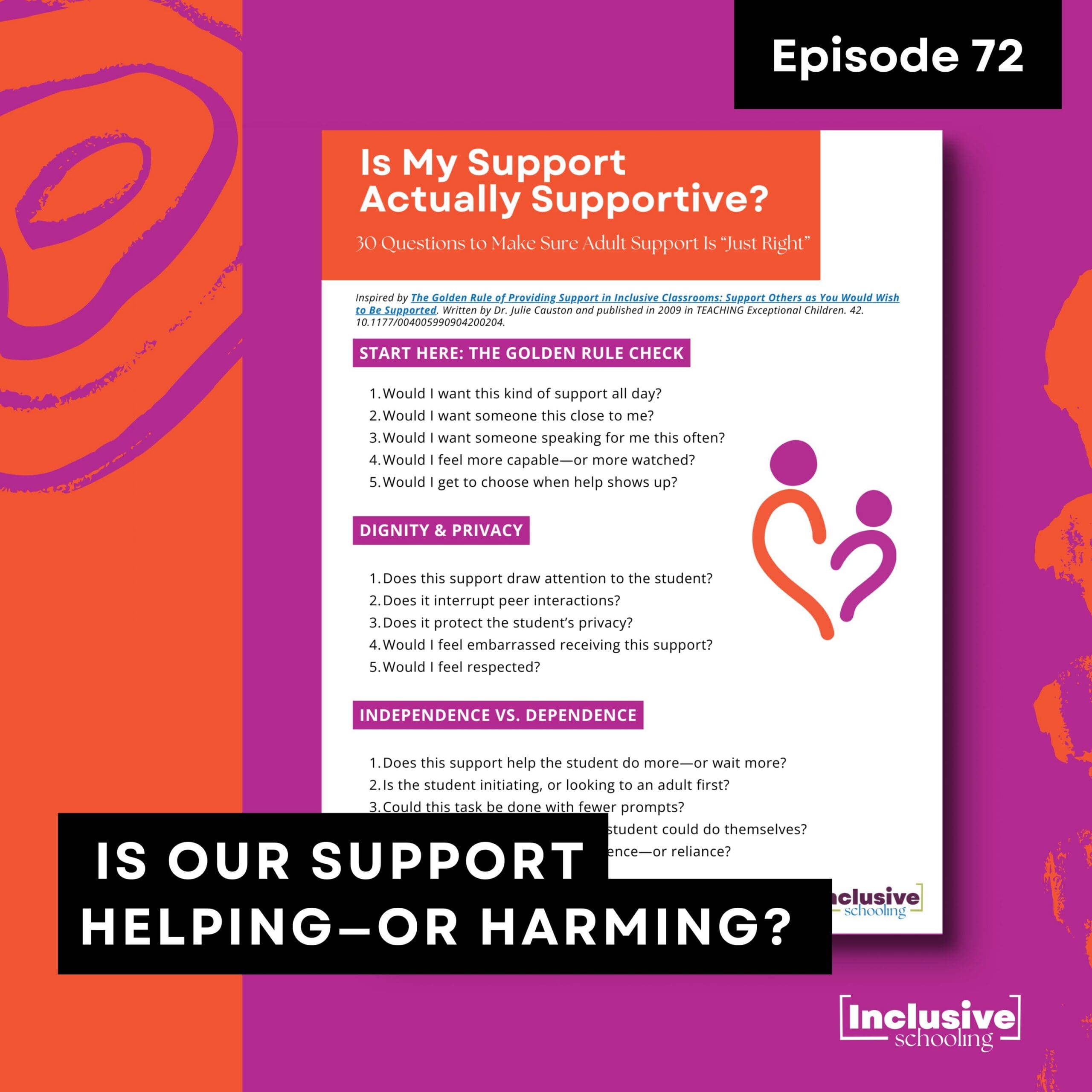
The Golden Rule of Support: Would You Want This Help?
Transcript [pdf]
SHOW NOTES
In this episode, Julie and Kristie explore one of the most important, and often overlooked, questions in inclusive education. While support is intended to increase access, participation, and independence, it can sometimes have the opposite effect.
Key Takeaways
-
- Support should increase dignity, belonging, and independence — not dependence.
- Well-intentioned support can unintentionally create barriers to peer relationships and learning.
- The impact of support matters more than the intention behind it.
- Students deserve a voice in how they are supported.
- Adult support should be faded, redesigned, and adjusted over time — not remain static.
- The goal is not constant proximity; the goal is access, participation, and growing independence.
How do you know if support is actually supportive?
Ask yourself:
-
- Would I want this kind of support all day?
- Would I want someone this close to me?
- Would I want someone speaking for me this often?
- Would I feel more capable — or more watched?
- Would I get to choose when help shows up?
If the answer is no, it may be time to rethink the support, not the student.
Why Support Sometimes Gets in the Way
Most educators enter the profession because they want to help. But support can become problematic when it:
-
- Separates students from peers
- Replaces teacher interaction
- Interrupts learning
- Limits creativity and problem-solving
- Creates dependence on adults
- Reduces opportunities for self-advocacy
When support becomes too close, too frequent, or too intrusive, it can unintentionally undermine the very goals of inclusion.
Episode Download / Handout
Is My Support Actually Supportive? 30 Questions to Make Sure Adult Support Is “Just Right”
This practical reflection tool helps educators, paraprofessionals, and teams evaluate whether support is increasing independence — or accidentally creating dependence.
Inside the download, you’ll find:
-
- The Golden Rule Check
- Questions focused on dignity and privacy
- Reflection prompts about independence versus dependence
- Tools for examining student choice and voice
- Questions about peer relationships and belonging
- A framework for fading and redesigning support
Why download it?
Because support is not automatically helpful just because it is well-intentioned. This tool helps teams pause, reflect, and ensure that support is respectful, effective, and aligned with inclusive values.
👉 Download at: inclusiveschooling.com/download72
Additional Resources
- A Comics Collection of the “Absurdities & Realities of Special Education” (Vermont Public interview with Michael Giangreco): Giangreco and illustrator Kevin Ruelle use satire and humor to expose common contradictions, bureaucratic barriers, and inequities within special education systems. Through concise cartoons and visual metaphors, the collection encourages educators, families, and advocates to critically examine practices related to inclusion, disability, and educational decision-making. The cartoons remain relevant because they illuminate enduring challenges while making complex issues accessible and memorable. These volumes are particularly valuable for professional development, reflective discussion, and promoting more inclusive educational practices.
Original cartoon collections:
- Giangreco, M. F., & Ruelle, K. (1998). Ants in His Pants: Absurdities and Realities of Special Education.
- Giangreco, M. F., & Ruelle, K. (1999). Flying by the Seat of Your Pants: More Absurdities and Realities of Special Education.
- Giangreco, M. F., & Ruelle, K. (2000). Teaching Old Logs New Tricks: More Absurdities and Realities of Education
- The Golden Rule of Providing Support in Inclusive Classrooms: Support Others as You Would Wish to Be Supported: Causton-Theoharis challenges educators to rethink traditional approaches to adult support in inclusive classrooms by applying a simple but powerful principle: support students in the ways we ourselves would want to be supported. Drawing on research and classroom examples, the article demonstrates how excessive adult proximity can unintentionally create dependence, limit peer relationships, interfere with creativity, and reduce student autonomy. The author offers practical strategies for fading adult support, increasing peer connections, and centering student voice and self-determination. This article remains a valuable resource for educators seeking to create inclusive learning environments that promote belonging, independence, and authentic participation for all students.
- Paraprofessional Ladder of Support: The Prompting Ladder provides a practical framework for delivering support in ways that promote student independence rather than dependence. Organized from least intrusive supports, such as natural cues and wait time, to more intrusive supports, such as physical prompting, the tool encourages educators to begin with the minimum level of assistance needed and increase support only when necessary. Using the memorable metaphor of climbing a ladder, the resource reminds educators to return to less intrusive supports as soon as possible so that students can develop autonomy, confidence, and competence. This visual guide is particularly useful for educators, paraprofessionals, and support staff seeking to balance meaningful assistance with high expectations for student independence.
- Definition of Inclusion: This concise resource defines inclusive education as a commitment to ensuring that all students learn, belong, and participate together in their neighborhood schools and classrooms. It challenges the assumption that separate settings are in the best interest of students with disabilities and emphasizes that belonging is a fundamental human need. The handout also outlines key features of inclusive education in practice, including shared ownership, meaningful participation, and access to grade-level learning opportunities. It serves as a clear introduction to the values and practices that support truly inclusive schools.
- Para-Bytes Paraprofessional Training — Inclusive Strategies for Schools: Para-Bytes is a comprehensive professional learning program designed specifically for paraprofessionals and support staff working in inclusive schools. Through 24 bite-sized, on-demand learning modules, participants explore practical strategies related to inclusion, academics, behavior, student independence, and belonging. The program combines research-based practices with immediately applicable tools, helping paraprofessionals build confidence while supporting students in ways that promote participation, relationships, and autonomy. Para-Bytes serves as a valuable resource for districts seeking consistent, high-quality professional development that strengthens inclusive practices across classrooms and schools.
- Inclusion Podcast Episode 49: Support Is a Verb — Not a Human: This resource challenges the common belief that supporting students in inclusive classrooms requires assigning more adults. Instead, it reframes support as the intentional actions educators take before, during, and after instruction to increase access, participation, learning, and belonging. Through practical examples and reflection, the resource encourages educators to focus on effective strategies — such as planning for access, leveraging peer support, and using subtle prompts—rather than relying solely on adult proximity. It offers a powerful reminder that meaningful support is measured by its impact, not by the number of adults present.