

Inclusive classroom scheduling plays a critical role in whether students truly belong or are unintentionally excluded, yet many schools build schedules that prioritize adult convenience over student access.
The Inclusive Schedule Trap: What Schools Keep Getting Wrong—and What to Do Instead
Transcript [pdf]
SHOW NOTES
What This Episode Is About
School schedules are often treated like a logistical puzzle, but they are actually one of the most powerful (and overlooked) levers for inclusive education.
In this episode, Julie and Kristie break down the most common mistakes schools make when building schedules, and how those mistakes quietly reinforce segregation, adult dependence, and inequity.
This episode is for you…if you are:
-
- A principal or district leader building a master schedule
- Trying to improve Least Restrictive Environment (LRE) outcomes
- Struggling with staffing, co-teaching, or paraprofessional use
- Seeing clustering of students with disabilities
- Feeling stuck in “we’ve always done it this way”
Key Takeaways
-
- The schedule is not neutral — it either supports inclusion or prevents it.
- Most schools accidentally design schedules around adults instead of students.
- Clustering students with disabilities is one of the most common and harmful scheduling mistakes.
- Over-relying on adults (especially paraprofessionals) often masks deeper instructional or system issues.
- Inclusive scheduling requires a clear sequence: students first, then educators, then paraprofessionals.
- Natural proportions create balanced classrooms that support both students and staff.
Answering a Common Question
How do you create an inclusive school schedule?
By flipping the traditional process.
Instead of scheduling adults, programs, or rooms first, inclusive scheduling follows this order:
-
- Schedule students first based on support needs and natural proportions
- Schedule educators next to align with those student needs
- Schedule paraprofessionals last to support — not drive — the system
Episode Download / Handout
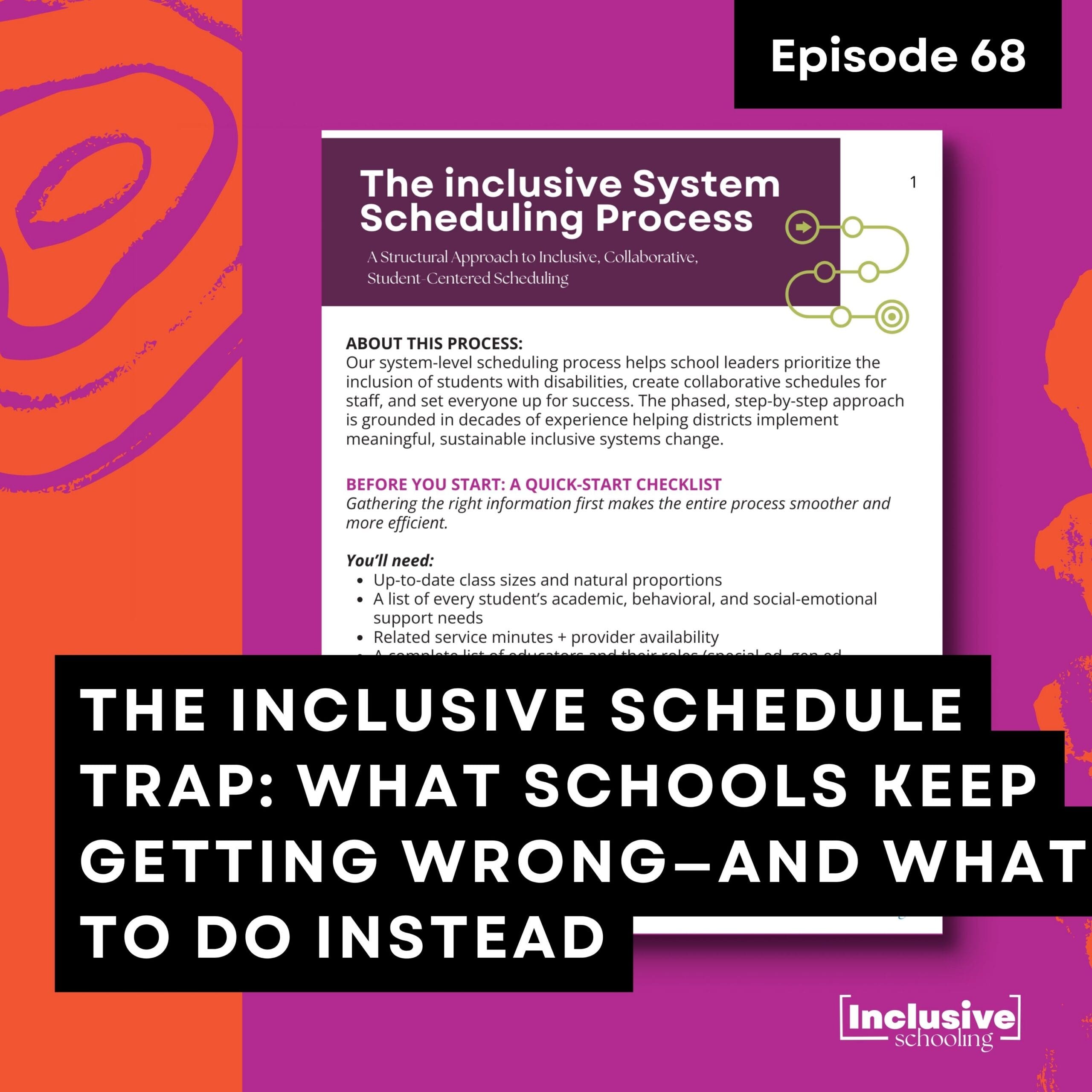
The Inclusive System Scheduling Process
This step-by-step resource gives school leaders a clear, structured process for building inclusive schedules from the ground up.
Inside the download, you’ll find:
-
- A quick-start checklist to gather the right data before scheduling
- A 3-phase scheduling process (students → educators → paraprofessionals)
- Step-by-step guidance for placing students using natural proportions
- Strategies for aligning staff roles with student needs
- Clear guidance for reducing fragmentation and improving collaboration
- 13 common scheduling pitfalls — and exactly how to avoid them
- Reflection questions to evaluate your final schedule
Why download it?
Because most scheduling problems are not technical, they’re structural. This tool helps you stop patching problems and start designing systems that naturally support inclusion, access, and belonging.
👉 Download at: inclusiveschooling.com/download68
The Biggest Scheduling Mistake Schools Make
Most schools:
-
- Build the schedule around specials, staff availability, or programs
- Place students with disabilities last
- Cluster students with similar needs together
- Move students to where adults already are
This leads to:
-
- Segregated classrooms
- Overloaded “high-need” rooms
- Adult-dependent environments
- Reduced access to peers and grade-level instruction
What Are “Natural Proportions” (and Why Do They Matter?)
Natural proportions mean that classrooms reflect the overall percentage of students with disabilities in the school.
For example:
-
- If 12% of your school has disability labels
- Then roughly 12% of each classroom should reflect that diversity
This prevents:
-
- Clustering
- Overwhelming any one classroom
- Creating hidden self-contained environments
What to Watch For (Common Pitfalls)
-
- Scheduling adults before students
- Clustering students with significant needs
- Overusing paraprofessionals as the primary support
- Creating “para-heavy” or “high-need” classrooms
- Assigning 1:1 support without a clear decision process
- Using adult support to fix instructional gaps instead of improving Tier 1
Additional Resources
Inclusive Structural and Instructional Practices Self-Assessment: This comprehensive tool designed to help educators and school leaders reflect on their current inclusive practices across systems, structures, and classroom instruction. It guides individuals and teams to evaluate their beliefs, skills, and systemic supports while identifying strengths, priorities, and actionable next steps. The resource emphasizes key structural practices and high-impact instructional strategies — such as co-teaching, differentiation, natural supports, and inclusive behavior approaches — that foster belonging and meaningful participation for all students. By engaging in this reflective process, schools can move from intention to action and build more inclusive, equitable learning environments.
Inclusion Podcast Episode 18- My (Un)Special Education: In this episode of The Inclusion Podcast, Brianna Dickens shares powerful and personal insights about how behavior is often misunderstood in schools. Through both humor and lived experience, she challenges the idea that challenging behavior is a problem to fix, reframing it instead as meaningful communication and often a sign of intelligence. The conversation invites educators and families to look beyond surface-level behaviors and respond with curiosity, respect, and a presumption of competence. Listeners will leave with a deeper understanding of behavior and a renewed commitment to supporting all students in more inclusive, human-centered ways.
The Way to Inclusion: This book is a practical, research-based guide that supports school leaders in creating systems where every student truly belongs. The book walks readers through a clear, step-by-step process for inclusive change, including defining a shared vision, examining current practices, and redesigning structures and roles to better serve all learners. Grounded in real examples, tools, and actionable strategies, it helps teams move beyond intention to implementation with confidence. By focusing on leadership, collaboration, and equity, this resource empowers schools to build sustainable, inclusive environments where all students can thrive.