

IEP goals are meant to support access to learning, not measure whether a student will comply with tasks they don’t want to do.
But many goals still center on staying on task, following directions, or completing non-preferred work. These may seem reasonable, but they prioritize compliance over skill development.
And that’s where things start to go off track.
It often shows up like this:
Writing IEP goals about completing unpreferred tasks.
It might sound like:
staying on task
following directions
reducing refusal
tolerating demands
On paper, those goals look reasonable.
But they’re not learning goals. They’re compliance goals.
If a student can only meet a goal by being uncomfortable, quiet, or compliant, we have to ask:
What are we actually teaching?
Because IEPs are not designed to teach students to endure school. They are designed to support access to learning. When goals drift toward compliance, a few predictable things happen:
- Students learn to suppress discomfort instead of communicate
- Staff focus on control instead of instruction
- Behavior becomes the problem instead of the signal
The Problem Isn’t the Student. It’s the Task
When a student avoids a task, the default assumption is:
“They need to try harder.”
But adults don’t operate that way. We, avoid tasks, modify them, delegate them, redesign them, and find workarounds. Students should be allowed the same problem-solving. Because most “unpreferred tasks” lack one relevance, choice, access, or support.
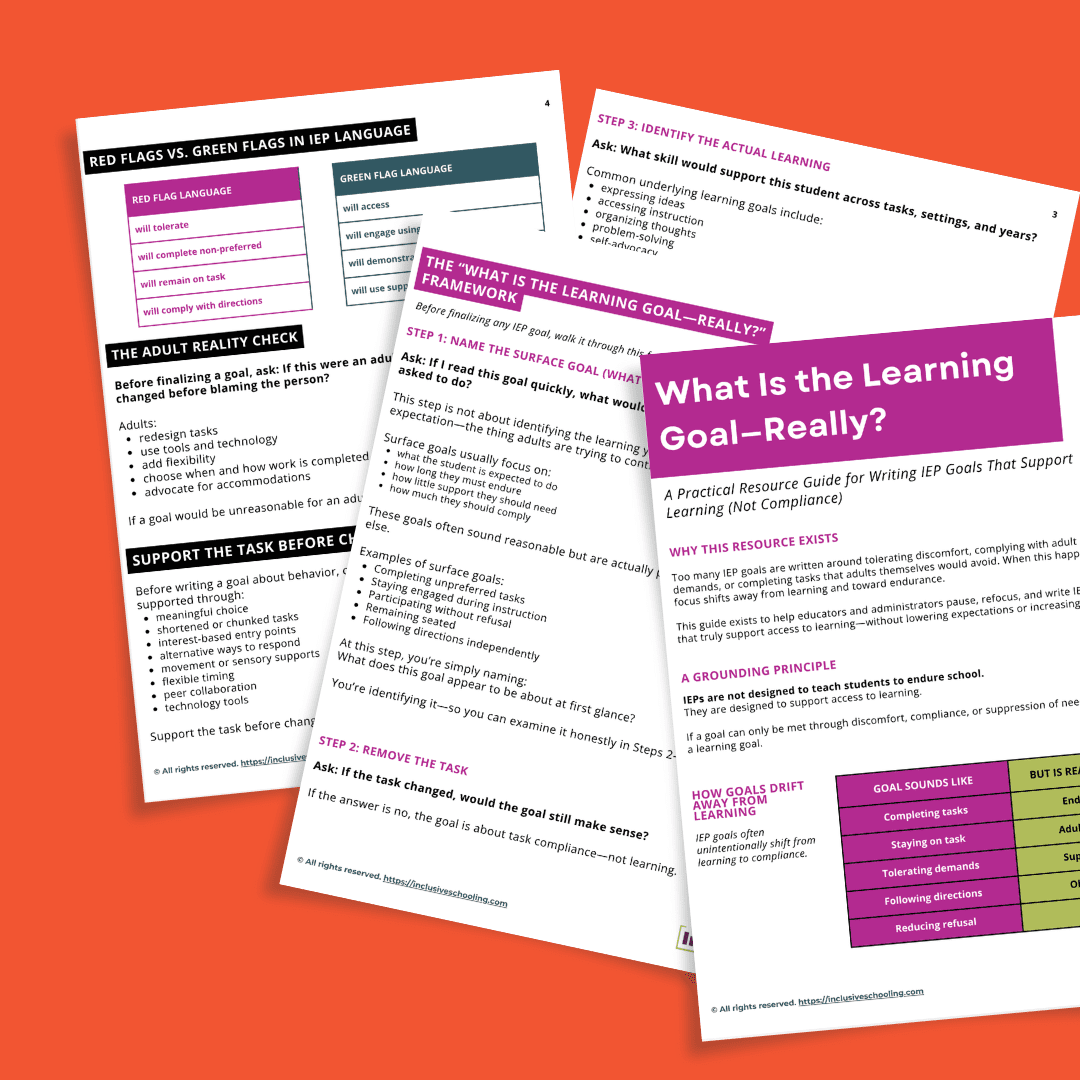
What to Look for in Your Current IEPs
If you want a quick audit, scan your IEP goals for this language:
- will tolerate
- will remain on task
- will complete non-preferred work
- will comply with directions
These are red flags. They signal endurance, not learning.
Now compare that to language that reflects access:
- will access instruction
- will engage using supports
- will use strategies to participate
For example, instead of: “Student will complete non-preferred tasks for 15 minutes.” Shift to: “Student will engage in learning using supports, choices, and flexible options.” Or, iInstead of:
“Student will stay on task”, shift to “Student will access instruction through multiple participation options, including movement, tools, peer collaboration, or alternative formats”
Why shouldn’t “completing unpreferred tasks” be an IEP goal?
Because it measures compliance, not learning. If a goal focuses on endurance or obedience, it does not improve access to instruction or long-term outcomes.
What should IEP goals focus on instead?
IEP goals should focus on skills that help students access learning, such as communication, engagement, self-advocacy, and using supports effectively.
How can leaders help teams shift away from compliance-based goals?
Start by asking better questions. Have teams identify the real learning goal, examine whether tasks can be adjusted, and replace compliance language with access-focused language.