When “They Need a Small Group” Is Code for Exclusion
Transcript [pdf]
SHOW NOTES
What This Episode Is About
In this episode, Julie and Kristie unpack one of the most common phrases used in schools, and one of the most misunderstood.
“We love inclusion, but this student really needs a small group.”
While small group instruction is a powerful and evidence-based teaching strategy, it is often used as a justification for removing students from general education classrooms.
The problem?
Small group instruction is a strategy… not a location.
Key Takeaways
-
- Small group instruction is not a place, it is an instructional strategy.
- Students do not need to leave general education classrooms to benefit from small groups.
- Pull-out services often become the default solution before Tier 1 instruction is fully examined.
- When students only succeed outside the classroom, the environment, not the student, may need redesigning.
- Flexible, heterogeneous grouping benefits all learners.
- The first response to student struggle should be improving access and instruction, not changing placement.
Answering a Common Question
Do students with disabilities need small group instruction? Yes.
But needing small group instruction does not mean needing a separate classroom or space.
Effective small groups can happen:
-
- Inside general education classrooms
- During station teaching
- Through flexible grouping
- Through peer collaboration
- Through interest-based activities
- Through differentiated instruction
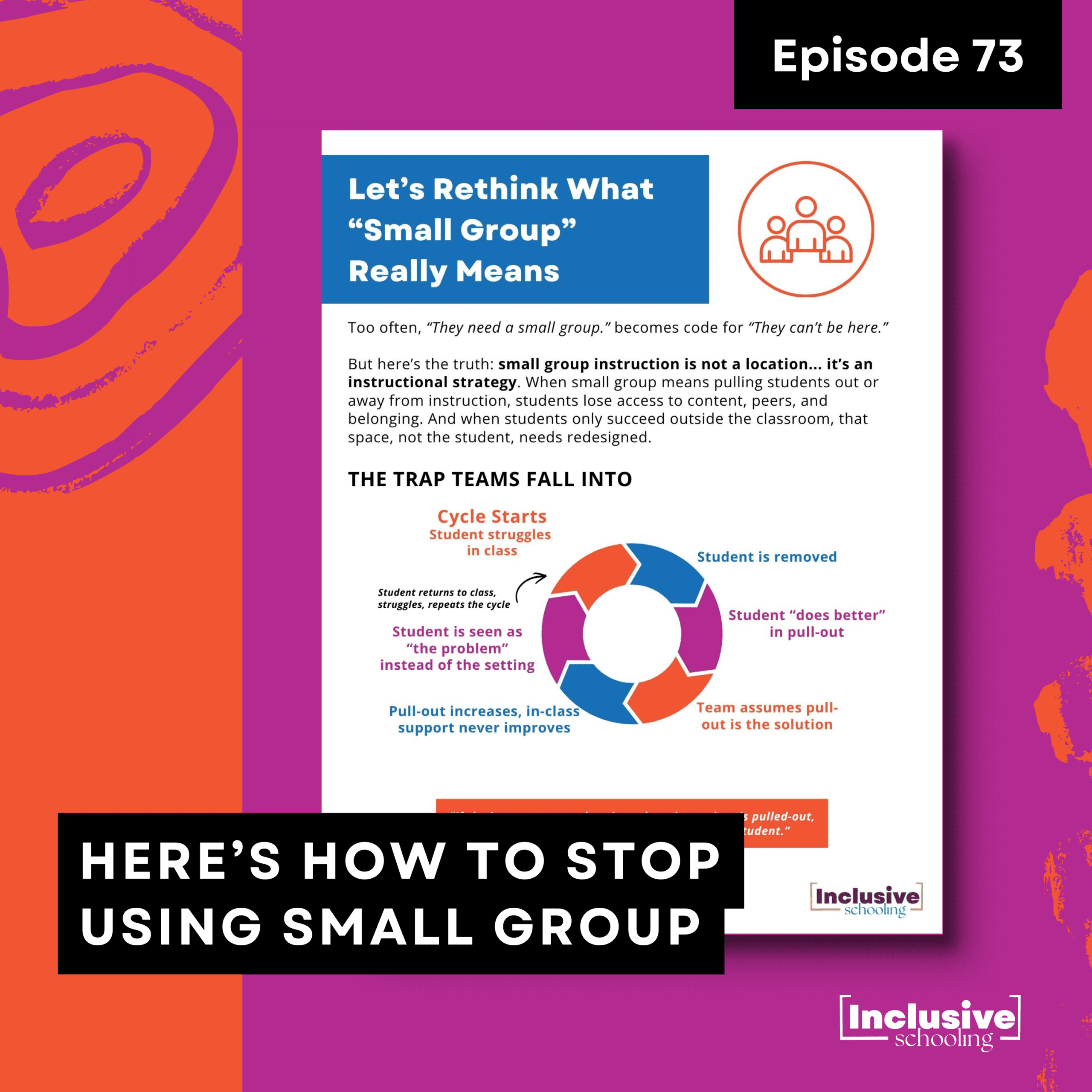
Many schools unintentionally follow this cycle:
-
- A student struggles in class.
- The student is removed for “small group instruction.”
- The student appears to do better.
- The team assumes the pull-out setting is the solution.
- More pull-out support is added.
- The general education classroom remains unchanged.
- The student becomes viewed as the problem rather than the instructional environment.
Over time, exclusion grows while instructional redesign never happens.
Episode Download / Handout
Let’s Rethink What Small Group Really Means – This practical guide helps educators redesign support without removing students from instruction, peers, or belonging.
Inside the download, you’ll find:
-
- A visual of the common “small group” trap schools fall into
- Research-based principles for effective small group instruction
- 25 practical ways to create meaningful small groups inside general education classrooms
- Strategies that do not require additional staff
- Ideas for increasing engagement, regulation, and participation
- Flexible grouping structures that support all learners
👉 Download at: inclusiveschooling.com/download73
What Instructional Experts Know About Effective Small Groups
Effective small group instruction:
-
- Uses flexible and temporary groups
- Includes diverse learners
- Builds student choice and ownership
- Supports participation in multiple ways
- Preserves access to peers and grade-level content
- Relies on intentional design rather than additional adults
Practical Ways to Create Small Groups Without Pull-Out
Instead of removing students, try:
-
- Student Choice Grouping – Let students choose partners or groups.
- Interest-Based Stations – Group students around interests and strengths.
- Think-Pair-Share – Include writing before speaking to increase participation.
- Success Checklists – Have students define what successful collaboration looks like.
- Clock Partners – Create diverse partner groupings ahead of time.
- Station Teaching – Build supports directly into instruction.
- Choice Boards – Offer multiple ways to engage with content.
- Partner, Individual, Group (PIG) Options – Let students choose how they work.
- Visual Schedules and Role Cards – Reduce adult prompting and increase independence.
- Cozy Corners and Regulation Supports – Help students regulate without leaving the classroom.