

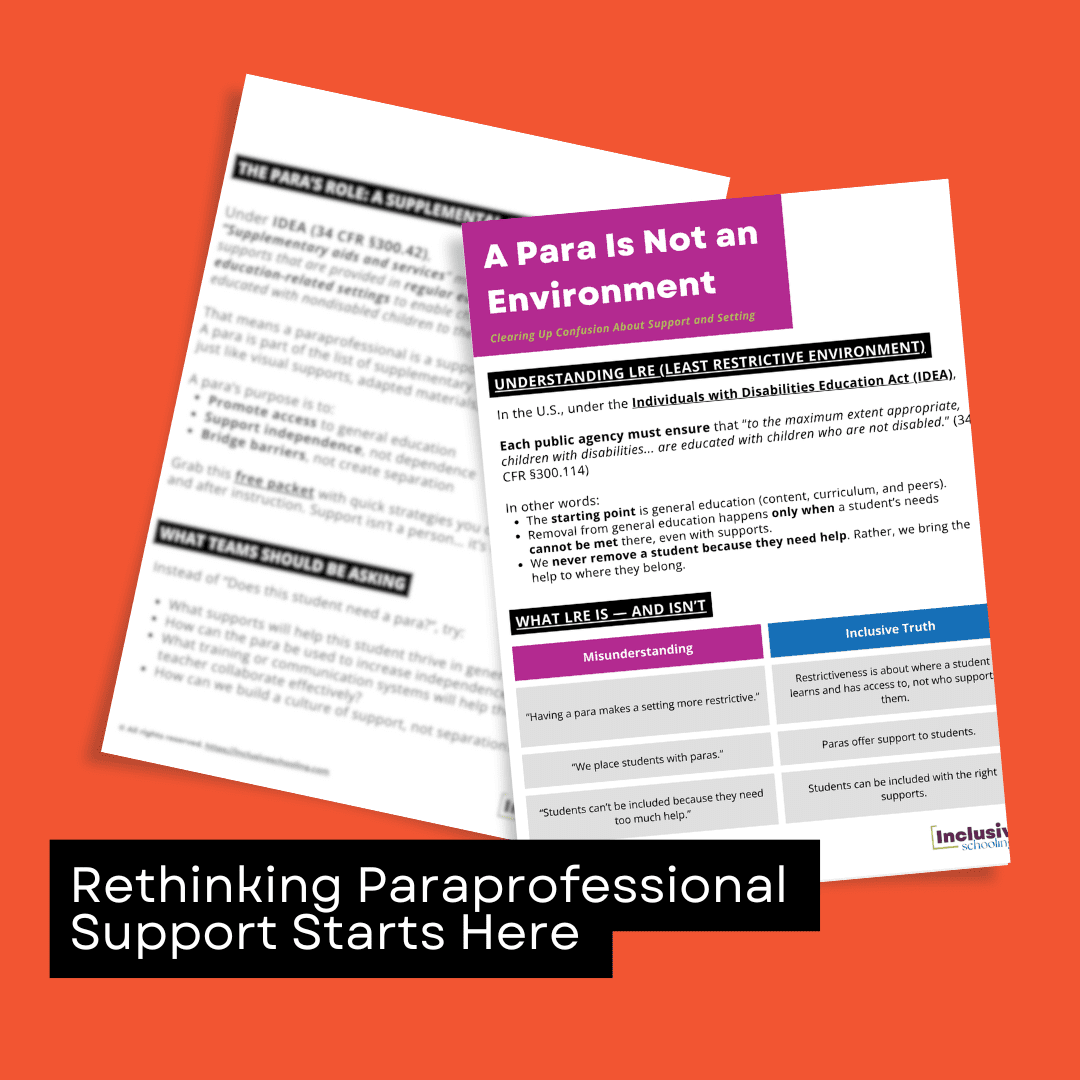
Needing a paraprofessional does not make a classroom more restrictive.
What makes an environment restrictive is reduced access to general education content, curriculum, and peers.
Yet across schools and districts, leaders still hear—and sometimes repeat—this misconception:
“A student can’t be included because they need a paraprofessional.”
That statement quietly undermines inclusion, misrepresents the law, and leads teams to place students in more restrictive settings than necessary.
Let’s clarify this once and for all.
The Core Distinction Leaders Must Get Right
To make legally sound, inclusive decisions, teams must separate placement from support.
- Placement answers one question:
Where does the student have the greatest access to general education peers, content, and curriculum? - Support answers a different question:
What supports help the student access, participate, and make progress there?
Paraprofessionals fall under supplementary aids and services.
They are supports, not environments.
A classroom does not become more restrictive because support is added.
It becomes more restrictive only when access is reduced.
Support is not defined by adult proximity—it’s defined by the intentional actions adults take to increase access, independence, interdependence, and belonging.
Why This Confusion Persists—and Why It’s Harmful
When teams blur support and setting, three things tend to happen:
- Students are removed unnecessarily
Instead of bringing support to the student, teams move the student to a segregated space. - Families are misinformed
Parents are told restrictive placements are “less restrictive,” when the opposite is true. - Independence and interdependence are delayed
Students miss opportunities to learn with peers and practice skills in authentic contexts.
Inclusion isn’t about the number of adults in the room.
It’s about the quality, portability, and purpose of support.
Three Language Shifts That Change Everything
Leaders set the tone for inclusive decision-making. These small but powerful language shifts help teams stay aligned:
- Instead of: “We place students with paraprofessionals”
Say: “We support students with paraprofessionals.” - Instead of: “They can’t be included because they need help”
Say: “They can be included with help.” - Instead of: “That classroom is too restrictive because of adult support”
Say: “Let’s examine whether the support is being delivered in the least intrusive way.”
These shifts keep the focus where it belongs: access, belonging, and progress.
What Leaders Should Ask in Real Time
When this issue comes up in meetings, walkthroughs, or placement discussions, pause and ask:
- Are we confusing support with setting?
- Does this decision increase or decrease access to general education peers and curriculum?
- Are supports being brought to the student—or is the student being moved because support feels inconvenient?
- Is the paraprofessional’s role focused on independence and interdependence, including peer connections and reduced adult proximity over time?
These questions prevent exclusion disguised as compliance.
Why This Matters
Every time we remove a student because they need support, we send the message that belonging is conditional.
When leaders get this right, students get what they are legally and ethically entitled to:
- Access
- Participation
- Progress
- And real inclusion alongside their peers
Support is how inclusion works—not how it’s restricted.
Does having a paraprofessional make a classroom more restrictive?
No. A paraprofessional is a supplementary aid and service—not a placement. A classroom becomes more restrictive only when a student has less access to general education peers, content, or curriculum.
Can a student be included if they need one-to-one paraprofessional support?
Yes. Students can and should be included with support when that support increases access and participation. Needing help does not justify removal from general education.
What should leaders say when teams claim inclusion isn’t possible because of support needs?
Pause the conversation and clarify the difference between support and setting. Ask whether the proposed decision increases access—or simply removes the student because support feels difficult to deliver.
