

Mini-Moments that Matter: Building Trust Without Tons of Time
Transcript [pdf]
SHOW NOTES
Key Takeaways
-
- Connection doesn’t require hours — it requires intention. The smallest moments of care, curiosity, or acknowledgment often have the biggest impact on trust and learning.
- Mini moments build safety. A quick check-in or question signals to students, “You matter to me,” creating emotional safety and regulation.
- Relationships and academics can coexist. You can build connection and cover content at the same time—often with just a few words or gestures.
- These moments are essential, not extra. Simple, human interactions can transform classrooms into places of belonging, empathy, and engagement.
- Connection doesn’t require hours — it requires intention. The smallest moments of care, curiosity, or acknowledgment often have the biggest impact on trust and learning.
Episode Download/Handout
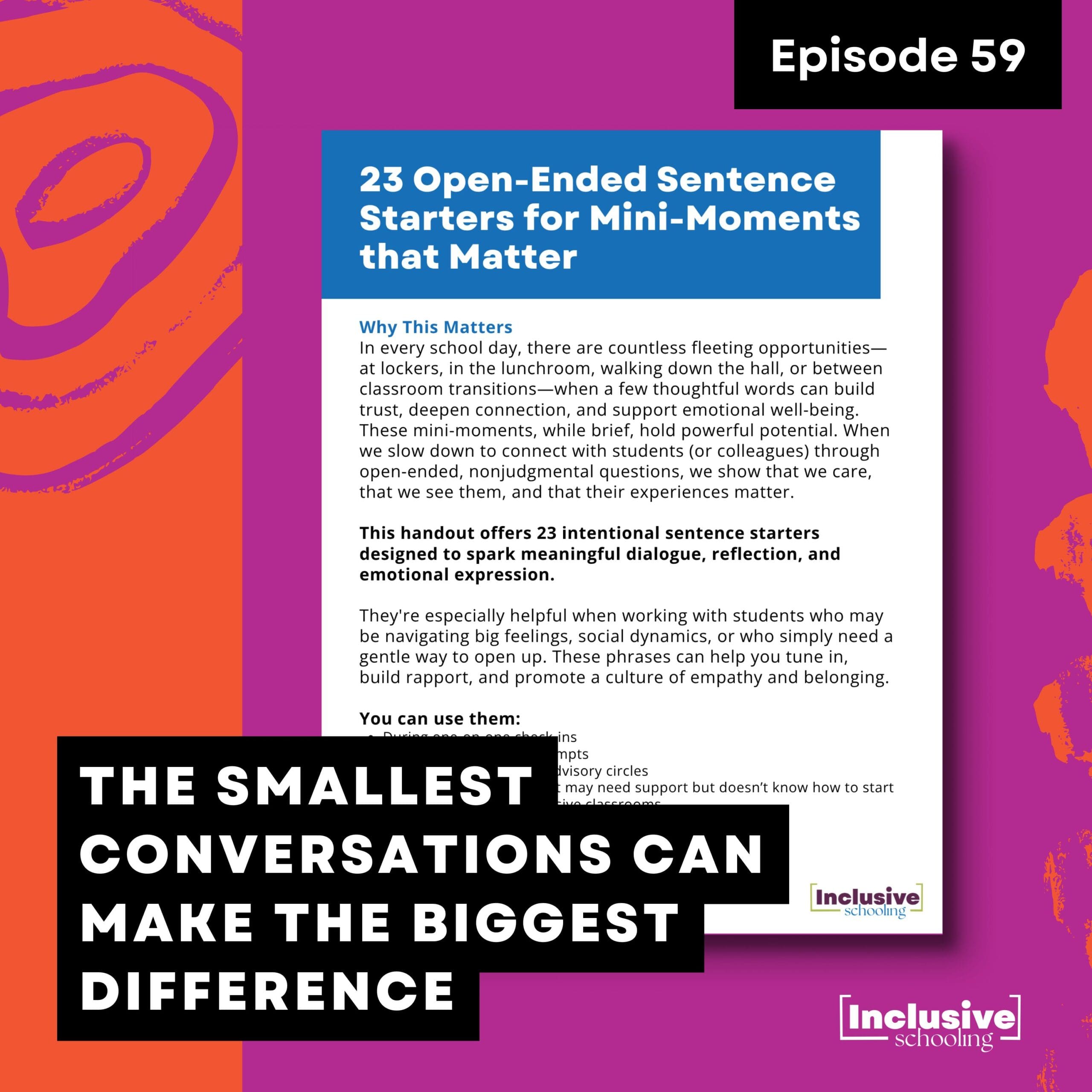
The free handout — 23 Open-Ended Sentence Starters for Mini-Moments That Matter — offers intentional ways to spark meaningful dialogue and connection throughout the day.
Use these sentence starters:
-
- During one-on-one check-ins
- As journal or drawing prompts
- In morning meetings or advisory circles
- When you sense a student needs support but doesn’t know how to start
- As reflection tools for inclusive classrooms
- During one-on-one check-ins
👉 Download at inclusiveschooling.com/download59.
Highlights from the Handout
- Julie’s Favorites:
- “I noticed you ___ today — tell me more.”
- “What are you hoping tomorrow feels like?”
- “Do you want company or space right now?”
- “You don’t have to say anything — I’m just glad you’re here.”
- “I noticed you ___ today — tell me more.”
- Kristie’s Favorite:
- “If your feelings today were a weather report, what would it be?” — a simple, playful way to check in without pressure or judgment.
Practical Tips
-
- Make it brief and intentional. Even a 10-second interaction can regulate a student’s nervous system and deepen trust.
- Keep it emotionally safe. Avoid forced disclosure — students can respond in whatever way feels comfortable.
- Use quick tools. Try “fist to five” or “thumb meter” check-ins to gauge how students are feeling and adjust your lesson flow.
- Don’t separate or single out. Gathering feedback isn’t about sorting by ability or emotion — it’s about noticing patterns and adjusting as a whole.
- Anchor the human connection. When students know they’re seen and valued, they’re more ready to learn, collaborate, and take risks.
- Make it brief and intentional. Even a 10-second interaction can regulate a student’s nervous system and deepen trust.
Learn More About Behavior 360: our newest on-demand PD!
How can school leaders make time for connection in busy school days?
Connection doesn’t require extra time—it requires intention. Mini moments are short, meaningful interactions that fit naturally into daily routines: a greeting in the hallway, a quick check-in before class, or a kind word during dismissal. When leaders model connection as part of the workday, it becomes embedded in school culture rather than added to it.
What are examples of mini moments that build trust in classrooms?
Mini moments are brief exchanges that communicate safety, belonging, and care. Examples include asking, “How are you feeling about today?” or leaving a note that says, “I’m glad you’re here.” These gestures take seconds but can de-escalate stress, strengthen trust, and help students (and staff) regulate.
Why should school leaders focus on small moments instead of large initiatives?
Because lasting change happens in relationships, not programs. When teachers feel seen, valued, and supported, burnout decreases and collaboration grows. Small, consistent interactions build the emotional safety that makes every other initiative—academic or behavioral—more successful.